What Is a Plastic Extruder? The Complete 2026 Guide
A plastic extruder is a machine that melts raw plastic material and forces it through a shaped die to produce a continuous profile of uniform cross-section. It is the core machine in the plastic extrusion process — used to manufacture pipe, tubing, sheet, film, wire insulation, and dozens of other plastic products found in construction, automotive, packaging, and medical industries.
At a Glance
- Core function: Melts, mixes, and pumps molten plastic through a die to form continuous profiles
- Main input materials: PVC, polyethylene (PE), polypropylene (PP), ABS, nylon, and other thermoplastics
- Output examples: Pipes, window profiles, sheet, film, tubing, cable jacketing
- Two machine types: Single-screw extruder and twin-screw extruder
- Key process variables: Temperature zones (commonly reported ranges vary by material, typically 150–300 °C), screw speed (RPM), and die pressure
- Industry standards: ASTM D3222 for PVC pipe[1], ASTM D1248 for polyethylene[2] — requirements the machine and process must meet before production
- Cost range: Lab-scale units from roughly $5,000; industrial production lines from $50,000 to over $500,000 depending on throughput and configuration
What Plastic Extrusion Actually Is — and the Mistake That Costs Engineers Money
If you’re asking what is a plastic extruder and how it differs from other plastics machinery, start here: plastic extrusion is a high-volume manufacturing process that converts solid plastic pellets or powder into a continuous, shaped product. The process is continuous — meaning the machine runs without stopping, unlike injection molding which operates in discrete cycles.
Here is the error that costs engineers time and money: treating plastic extrusion as a generic “melting and shaping” step, then under-specifying the die, the cooling line, or the screw geometry. A process engineer who has specified hundreds of extrusion lines will tell you the die and downstream equipment define the product; the extruder itself is the pump that gets material there.
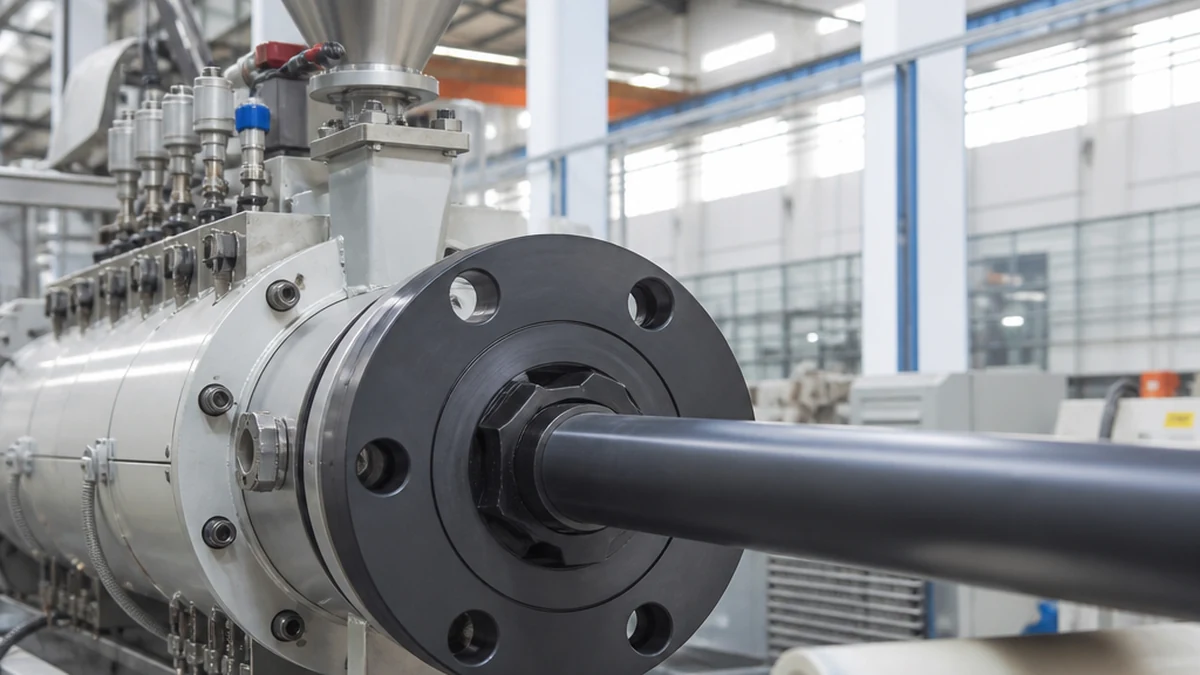
The plastic extrusion process begins with raw plastic material fed into a hopper. Heat and mechanical shear from a rotating screw melt the material as it travels down the barrel. The molten plastic is then forced through a die — a precision-machined opening — which gives the extruded plastic its final cross-sectional shape.
After the die, the continuous profile passes through a cooling station (typically a water bath or air cooling system) and is pulled by a haul-off unit at a controlled speed to maintain dimensional accuracy.
This is a thermoplastic process: the plastic materials soften when heated and solidify when cooled, and that cycle is reversible. Thermosets cannot be processed this way[3] — once cured, they cannot be remelted, which makes them incompatible with continuous extrusion manufacturing.
That single property — reversibility — is what makes thermoplastics the foundation of continuous extrusion manufacturing.
9 Core Components of a Plastic Extruder (and the One Most Buyers Underestimate)
Understanding what a plastic extruder does requires understanding its anatomy. Each part of the machine controls a specific variable in the process, and a weakness in any one component degrades the entire production run.
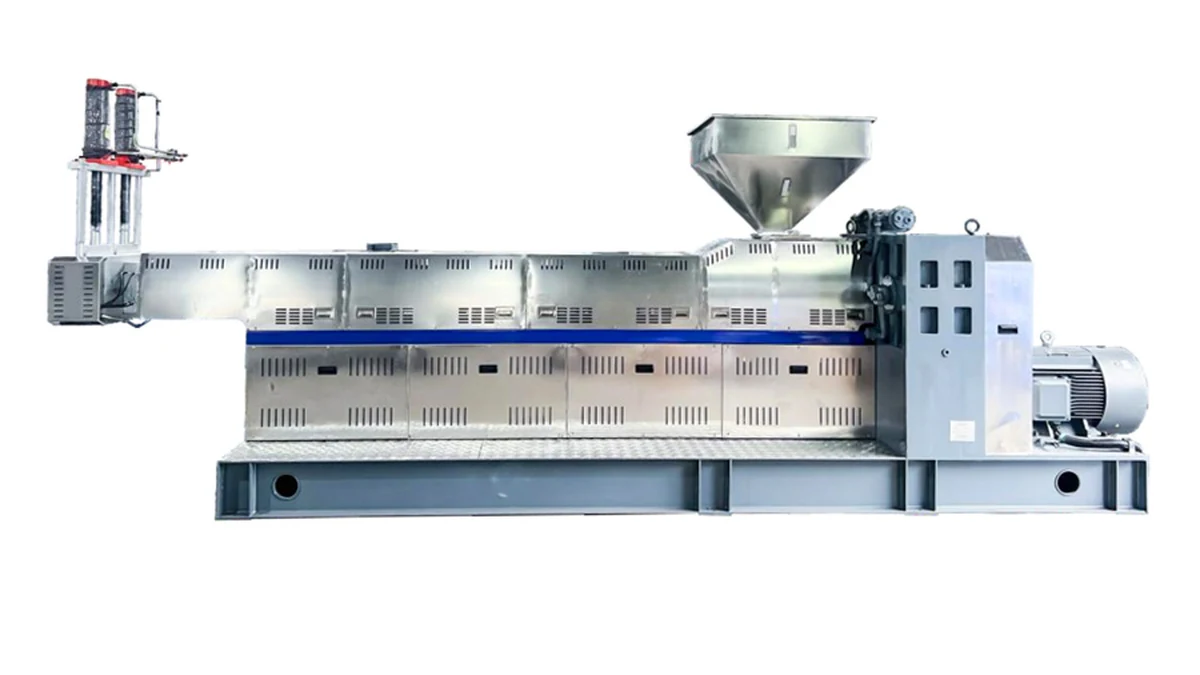
The major parts of a plastic extruder:
- Hopper — feeds raw plastic pellets or powder into the barrel; sometimes equipped with a dryer for moisture-sensitive materials like nylon or PET
- Barrel — the heated cylinder housing the screw; divided into multiple temperature zones that progress from feed zone to metering zone
- Screw — the rotating element that conveys, compresses, melts, and meters the plastic; screw geometry (L/D ratio, compression ratio) is specific to the material being processed
- Heater bands — wrap the barrel exterior; zone temperatures vary significantly by material, from around 150 °C for soft PVC to above 280 °C for engineering-grade plastics
- Drive motor and gearbox — power the screw; output torque, not just horsepower, determines what materials and throughputs are achievable
- Screen pack and breaker plate — filter contaminants from the molten plastic and build back-pressure for melt homogeneity
- Die — the precision tooling that shapes the melt into the final profile, pipe, sheet, or film
- Cooling system — water bath, vacuum calibration tank, or air ring depending on the product
- Haul-off and cutter — pull the extruded plastic at a controlled rate and cut it to length
Our engineers at MQ have spent 15-plus years refining screw geometry for specialty material applications. The single most under-valued component in most customer builds is the screen pack. Industry troubleshooting guides consistently identify fouled screens as a leading cause of pressure spikes and surface defects that get misdiagnosed as temperature problems — and the Society of Plastics Engineers[4] reinforces this in its extrusion troubleshooting resources.
⚠️ Avertissement : Never operate an extruder without a functional screen pack. Running without filtration allows unmelted particles and contaminants into the die, causing surface defects, dimensional drift, and — in worst cases — die damage that requires full tooling replacement.
How a Plastic Extruder Works: The Mechanism in Detail
The operating principle of a plastic extrusion machine combines three physical phenomena simultaneously: heat conduction from the barrel, frictional heat generated by screw shear, and mechanical pressure.
As the screw rotates, its flights push material forward through three functional zones. In the feed zone, solid pellets are conveyed forward. In the compression zone, the channel depth decreases, compressing and beginning to melt the plastic. In the metering zone, a shallow, constant-depth channel homogenizes the molten plastic and delivers it to the die at a steady pressure and temperature.
The die pressure matters more than most buyers anticipate. For pipe extrusion, die pressures commonly fall in the range of 1,000 to 3,000 psi depending on material viscosity and throughput — though actual values vary with screw design and resin. Control systems monitor melt pressure in real time; a drop in pressure usually signals a screw wear problem or feed interruption.
After the die, cooling rate is the variable that controls internal stress in the extruded plastic. Cool too fast and you lock in residual stress; too slow and dimensional control suffers. Vacuum calibration tanks are standard for rigid pipe and profiles, where concentricity and wall thickness tolerance are critical quality requirements.
2 Types of Plastic Extruders: How to Choose the Right One
The single-screw and twin-screw extruder are not interchangeable. Choosing the wrong type is an expensive mistake — one we see more often on first-time configurations than on replacement orders.
| Feature | Single-Screw Extruder | Twin-Screw Extruder |
|---|---|---|
| Screw configuration | One screw in barrel | Two intermeshing or co-rotating screws |
| Best for | Homogeneous pellet-fed thermoplastics (PE, PVC, PP) | Compounding, filled materials, powders, PVC dry blend |
| Mixing capability | Distributive mixing only | High distributive + dispersive mixing |
| Typical cost | Lower | Significantly higher |
| Throughput control | Screw speed + downstream haul-off | More independent control over shear and mixing |
| Common applications | Pipe, film, sheet, wire coating | Compounding, masterbatch, PVC window profile |
| L/D ratios common | 24:1 to 36:1 | 40:1 to 56:1 for compounding |
If you’re producing pressure pipe for potable water, HDPE with a single-screw machine is the standard U.S. choice. PVC pipe for DWV applications requires a twin-screw to handle dry-blend powder — the twin-screw’s dispersive mixing prevents unmelted powder pockets that a single-screw simply cannot eliminate.
Single-screw systems dominate volume production of commodity plastic products. Twin-screw systems earn their higher price when the process requires intensive mixing — adding fillers, colorants, flame retardants, or processing aids to the base plastic material.
4 Plastic Extrusion Processes — Which One Matches Your Product?
Plastic extrusion machinery is not a single process — the die configuration and downstream equipment define four distinct process types, each producing a different class of plastic products across multiple industries.
1. Pipe and tubing extrusion
A hollow die with a mandrel produces continuous pipe and tubing. Downstream vacuum calibration maintains the outer diameter while internal air pressure stabilizes the bore. PVC pressure pipe, polyethylene gas pipe, and medical-grade tubing are all manufactured this way. ASTM standards for PE pipe[5] govern the dimensional tolerances and pressure ratings the process must achieve.
2. Profile extrusion
Custom-shaped dies produce complex cross-sections: window frames, door seals, deck boards, and hundreds of industrial profiles. Profile extrusion demands more careful die design than pipe because asymmetric shapes can cause differential cooling and warpage.
3. Sheet and film extrusion
A flat die (also called a slot or coat-hanger die) produces continuous plastic sheet or film. Thicker gauge material (over 0.01 inches) is typically called sheet; thinner output is film. Applications include thermoforming feedstock, packaging film, and agricultural mulch film. Sheet lines commonly use a three-roll stack for calendering and cooling.
4. Wire and cable coating
A crosshead die is mounted perpendicular to the extruder barrel. The wire or cable core is fed continuously through the die center while molten plastic is applied around it. This produces the insulation and jacketing on electrical wire and data cables — one of the most demanding applications for dimensional consistency in plastics manufacturing.
💡 Conseil de pro : Profile extrusion tooling costs — the die itself — can run $3,000 to $15,000 for a complex cross-section. Get die design reviewed by your material supplier before committing, because a die machined for rigid PVC will need modifications to run the same profile in a softer compound.
Material Selection: Matching Plastic to Machine
Not every thermoplastic processes equally well, and the choice of plastic material has a direct effect on machine configuration, screw design, and downstream cooling requirements. Picking the wrong material-to-machine pairing doesn’t just reduce output quality — it can degrade the resin, damage the screw, and void process warranties.
The most commonly extruded plastic materials in U.S. manufacturing include:
- PVC (Polyvinyl Chloride) — the workhorse of pipe and profile extrusion; requires careful temperature control because it degrades and releases corrosive gases above its processing window. If you’re running PVC dry-blend powder, specify a twin-screw system. OSHA guidelines for PVC thermal decomposition[6] apply to operator safety requirements.
- Polyethylene (PE/HDPE/LDPE) — straightforward to extrude on a single-screw machine; HDPE is the dominant material for gas pipe, water pipe, and corrugated drainage pipe in the United States. Tolerates a wide processing window.
- Polypropylene (PP) — common in sheet for thermoforming and in profile applications; narrower melt window than PE and more sensitive to moisture. Better suited to single-screw systems in most commodity applications.
- ABS — requires pre-drying; used in sheet for thermoforming, pipe, and industrial profiles. Specify a dryer-equipped hopper.
- Nylon (PA) — engineering material requiring thorough pre-drying (typically to below 0.2% moisture per resin supplier technical data sheets) and precise temperature control; used in tubing and specialty profiles where single-screw machines with vented barrels are common.
Material selection also determines the life cycle implications of the extruded plastic product. Thermoplastics extruded into pipe or profile can, in principle, be reground and re-extruded, which is why plastic extrusion plays a role in the closed-loop recycling economics[7] of materials like PE and PP.
The actual service life of a buried plastic pipe — a 50-year design life for HDPE per ASTM F714[5] — illustrates why material selection and process quality compound over decades. A poorly processed pipe wall that meets dimensional spec on Day 1 may fail hydrostatic stress tests years earlier than the design life predicts.
Where Plastic Extrusion Is Used — and Its Real Limits
Plastic extrusion produces a wide range of products across industries: PVC window profiles, polyethylene water pipe, polypropylene sheet for food packaging, wire insulation, greenhouse film, cable conduit, and automotive weatherstripping. In U.S. construction alone, extruded plastic profiles and pipes appear in virtually every new commercial and residential build.
What plastic extrusion is used for — by industry:
- Construction: PVC pipe, conduit, window and door profiles, vinyl siding
- Utilities: PE gas distribution pipe, HDPE water main
- Packaging: LDPE film, PS sheet for thermoforming, blister pack material
- Electrical: wire insulation, cable jacketing, conduit
- Médical : tubing for IV lines, catheters, and fluid transfer
- Agriculture: irrigation pipe, greenhouse film, geomembrane sheet
The process is genuinely not suited to every application. Extrusion produces only constant cross-sections — if a product’s shape changes along its length, a different process is needed. The process’s greatest strength — continuous output — is also its chief constraint: you cannot extrude a part that changes shape along its length, which is why injection molding remains dominant for complex 3-D geometries despite its higher per-part tooling cost.
Tooling lead times of 4 to 12 weeks for a custom die mean the process rewards high-volume, stable designs rather than short-run prototyping.
How Much Does a Plastic Extruder Cost?
A realistic answer requires separating the machine from the line. The extruder itself — barrel, screw, drive, and controls — is one cost center. The downstream equipment (cooling tank, haul-off, cutter, winder) is often an equal or larger investment.
Rough price ranges for the U.S. market:
- Lab-scale single-screw extruder (20 mm, bench-top, for R&D): $5,000–$20,000
- Small production single-screw (45–65 mm, 20–150 kg/hr): $30,000–$80,000
- Full production twin-screw compounding line (75–95 mm): $150,000–$500,000+
- Complete pipe extrusion line (extruder + downstream): $80,000–$250,000 depending on pipe diameter and throughput
These figures are directional — actual pricing shifts with screw diameter, L/D ratio, control system sophistication, and whether the line is configured for a single material or multiple materials.
plastic extruder cost and configuration guide Our team at MQ has configured equipment for customers across more than 40 countries, and the pattern we see consistently is buyers underestimating total line cost when they budget for the extruder alone and treat downstream equipment as an afterthought. Most equipment manufacturers also provide process support during line commissioning — factor that into your supplier evaluation, not just the machine price.
What a Plastic Extruder Operator Does
A plastic extruder operator is the person responsible for setting up, monitoring, and adjusting the extrusion line during production. The role is more process-intensive than it appears from the outside.
Daily responsibilities typically include:
- Setting and verifying temperature zone profiles before startup
- Monitoring melt pressure, screw speed, and haul-off speed to hold dimensional tolerances
- Pulling and measuring product samples at defined intervals (wall thickness, OD, weight per meter)
- Changing screens when pressure differential signals filter fouling
- Performing purging procedures when switching materials or colors
- Documenting process parameters for quality traceability
The Bureau of Labor Statistics[8] classifies this work under Plastics and Rubber Workers, which reported a median hourly wage of $19.89 in the most recent available survey. The role requires understanding of material behavior, die design basics, and troubleshooting — not just button-pushing. Operators who understand why a pressure spike happens fix it in minutes; those who don’t often run bad product for an entire shift before escalating.
Three Misconceptions About Plastic Extruders That Cost Buyers Time and Money
“Extrusion and injection molding are basically the same process.”
They are not. Injection molding is a batch process that fills a closed mold cavity under high pressure and ejects a finished part. A plastic extruder runs continuously and produces indefinite-length profiles — the die is open, not a closed cavity. Mixing them up leads to completely wrong tooling quotes and lead-time expectations.
“Any extruder can run any plastic.”
Screw geometry is material-specific. A screw designed for LDPE will generate inadequate shear for rigid PVC and may cause degradation. A PVC-optimized screw run on nylon will under-melt. Matching the screw design to the plastic material is not optional.
“Higher screw speed always means higher output.”
Above an optimal RPM, additional screw speed generates excess frictional heat, degrades the plastic, and can reduce output quality faster than it increases throughput. The relationship between screw speed, output rate, and melt temperature is nonlinear and material-dependent. Process control — not maximum speed — defines production quality.
If you’re evaluating your first pipe extrusion line, the single most important spec to nail down before pricing is screw L/D ratio and whether your material arrives as pellets or dry blend — those two answers determine machine type and total line cost more than any other variable.
Custom tooling lead times of 4 to 12 weeks and downstream equipment costs that can match or exceed the extruder itself are the two figures most buyers wish they had factored in earlier. That’s where understanding what is a plastic extruder — the full system, not just the barrel and screw — pays off most directly.
Vous avez un projet ou un cahier des charges ? Contactez mqextrusion.com : ce sont de vrais ingénieurs qui vous répondront.
FAQ
What is an example of a plastic extrusion?
PVC pipe is one of the most common examples of plastic extrusion. A plastic extruder melts PVC pellets and pushes the molten material through a circular die, producing a continuous pipe that is then cooled, cut to length, and sold for plumbing or construction use. Other everyday examples include window frame profiles, polyethylene tubing, plastic shopping bags, wire insulation, and weatherstripping found in most American homes and vehicles.
How much does a plastic extruder cost?
A plastic extruder in the United States typically costs between $20,000 and $500,000 depending on screw diameter, output capacity, and automation level. Small single-screw lab extruders start around $5,000 to $20,000, while mid-range production machines run $80,000 to $200,000. High-output twin-screw extruders or complete turnkey extrusion lines can exceed $500,000. Used equipment is widely available and can cut costs by 30 to 60 percent.
Is plastic extrusion expensive?
Plastic extrusion has a high upfront equipment cost but is one of the most cost-efficient manufacturing processes at scale. Once tooling and dies are made, per-unit production costs drop significantly because the process runs continuously with minimal waste. For U.S. manufacturers producing high volumes of pipe, film, or profiles, extrusion typically delivers a lower cost per pound of finished product compared to injection molding or other plastic forming methods.
What does an extruder look like?
A plastic extruder looks like a large horizontal barrel mounted on a steel frame, with a hopper on top where plastic pellets are loaded. The barrel houses a rotating screw and is wrapped in electric heating bands. At one end sits a motor and gearbox that drive the screw; at the other end is the die, which gives the extrudate its final shape. Most production extruders are roughly the size of a large workbench to a full room, depending on output capacity.
Sources
[1] Classification Standards — plasticpipe.org
[2] D1248 Standard Specification for Polyethylene Plastics… — store.astm.org
[3] Thermoset vs Thermoplastic (What is the Difference?) – TWI — twi-global.com
[4] Melt Pressure Instability: Causes & Solutions — cofit.com
[5] Standard Specification for Polyethylene (PE) Plastic Pipe… — store.astm.org
[6] OSHA Technical Manual (OTM) – Section II: Chapter 1 — osha.gov
[7] U.S. Recycling Infrastructure Assessment and State Data… — epa.gov
[8] Metal and Plastic Machine Workers — bls.gov