Prix des extrudeuses de plastique en Inde : ce que les acheteurs américains doivent savoir
Sourcing teams who skip the specification conversation and jump straight to price comparisons routinely receive machines that run fine on day one and fail within six months — because output capacity, screw geometry, and material compatibility were never confirmed against the actual production requirement.
This guide is for procurement managers, plant engineers, and startup founders evaluating plastic extruder machine price in India as a sourcing option, with realistic price bands, the spec details that actually drive cost, and the supplier questions that separate serious manufacturers from assemblers.
En bref
- Entry-level single-screw extruder machine (India-made): $3,000–$8,000 USD FOB
- Mid-range pipe making / blown film extruder: $8,000–$25,000 USD FOB
- Industrial HDPE pipe extrusion line or full plant: $25,000–$120,000+ USD FOB
- Tandem lamination plant or thick-plate PET/GPPS line: $60,000–$200,000 USD FOB
- Twin screw extruder (co-rotating, compounding grade): $18,000–$80,000 USD FOB
- Lead time: 45–90 days standard; 120+ days for custom die tooling
- MOQ: Typically 1 unit; spare parts orders often have minimum invoice thresholds of $500–$2,000 USD
- Key certifications to verify: CE marking, ISO 9001:2015, BIS compliance for Indian domestic components
- Typical payment terms: 30% T/T deposit, 70% against Bill of Lading
How much does a plastic extruder machine cost?
Price in India spans a 40-to-1 range depending on machine type, output capacity, and automation grade.[3] A bench-scale single-screw extruder machine used for laboratory testing might run $3,500 USD.[4] A full automatic 750 kg/hr PET/GPPS thick-plate extrusion line with hydraulic die change — a serious industrial machine plastic producers rely on for continuous runs — lands closer to $150,000–$190,000 USD ex-works.[5]
The three variables that compress or expand that range most dramatically:
- Screw diameter and L/D ratio — a 45mm screw at 25:1 L/D vs.[6] a 90mm at 33:1 L/D is not the same machine, even if both are listed as “single screw extruders”
- Material family — PVC extrusion demands corrosion-resistant screw and barrel liners; HDPE pipe extrusion needs high-torque drives; blown film runs require precision die lip control
- Automation grade — semi-automatic machines use manual haul-off and cutting; fully automatic extrusion lines integrate PLC-controlled puller, cutting machine, and stacker with closed-loop thickness feedback
📝 Note: Indian manufacturers quote prices in USD or INR depending on whether they export regularly. Always confirm whether the quoted price in Indian rupees includes local taxes such as GST, which apply in India but do not apply to export invoices — this distinction matters when benchmarking domestic Indian quotes against each other or against FOB export prices.
Plastic extruder machine price in India: quick reference by machine type
The table below summarises typical FOB price ranges for the machine categories U.S. buyers enquire about most frequently. All figures are USD and reflect India-made equipment quoted ex-works or FOB Indian port.
| Machine Type | Typical FOB Price Range (USD) | Typical Output | Common Application |
|---|---|---|---|
| Single-screw extruder (entry-level) | $3,000 – $8,000 | 20–80 kg/hr | PE/PP granules, lab testing |
| HDPE pipe extrusion line (complete) | $18,000 – $45,000 | 100–150 kg/hr | Water/gas pipe making |
| PVC pipe extrusion machine | $15,000 – $40,000 | 80–180 kg/hr | Conduit, pressure pipe |
| Blown film extruder (single-layer) | $7,000 – $14,000 | 50–80 kg/hr | Agricultural PE film |
| Blown film plant (3-layer) | $35,000 – $70,000 | 100–200 kg/hr | Barrier packaging film |
| Twin screw extruder (co-rotating) | $18,000 – $80,000 | 50–300 kg/hr | Compounding, masterbatch |
| ABS/PMMA sanitaryware plate line | $45,000 – $90,000 | 200–400 kg/hr | Bathtub/shower tray sheet |
| PET/GPPS thick-plate line (750 kg/hr) | $150,000 – $190,000 | ~750 kg/hr | Industrial trays, thermoforming |
| Tandem lamination plant | $80,000 – $160,000 | 150–300 m/min | Flexible packaging, paper-poly |
📝 Note: Prices are mid-range estimates based on supplier quotations and do not include die tooling, downstream equipment add-ons, freight, or electrical compliance work. Individual configurations vary significantly.
The machine types that actually matter for U.S. buyers
The Indian plastic machinery sector produces a wider machine range than most U.S. buyers expect. Understanding the sub-types prevents the most common sourcing error: ordering a general-purpose extruder for a specialized application.
Single-screw vs. twin screw extruder machines
Single screw extruders handle the majority of commodity extrusion — HDPE pipe making, PVC profile, blown film, and plastic granules production. They’re simpler to maintain, cheaper to source parts for, and well-understood by most plant operators.
Twin screw extruders (co-rotating) are the correct choice for compounding, filled materials, or applications requiring intensive mixing — glass-fiber-reinforced nylon, wood-plastic composite, or masterbatch production. The price premium is real: a twin screw extruder from a reputable Indian manufacturer typically costs 2–3× the equivalent single screw machine at the same throughput.
Don’t buy a twin screw extruder machine for a straight unfilled pipe making application — it’s the wrong tool and you’ll pay in maintenance complexity. Note that filled or composite pipe and profile materials, such as wood-plastic composites, may still warrant a twin screw configuration.
Blown film extruder and film plant configurations
Blown film lines from Indian manufacturers range from single-layer mono layer extrusion machines (for basic PE agricultural film) to 3-layer and 5-layer co-extrusion film plants for barrier packaging. A single-layer film extruder running 50–80 kg/hr is a practical entry point at $7,000–$14,000 USD. A 3-layer blown film plant with IBC (internal bubble cooling) and gravimetric blending runs $35,000–$70,000 USD from established manufacturers.
The layer count is not cosmetic — it determines whether the film can be used for food-contact or medical packaging applications, which require specific resin combinations that a single-layer machine physically cannot produce.
Pipe extrusion lines — HDPE and PVC pipe machines
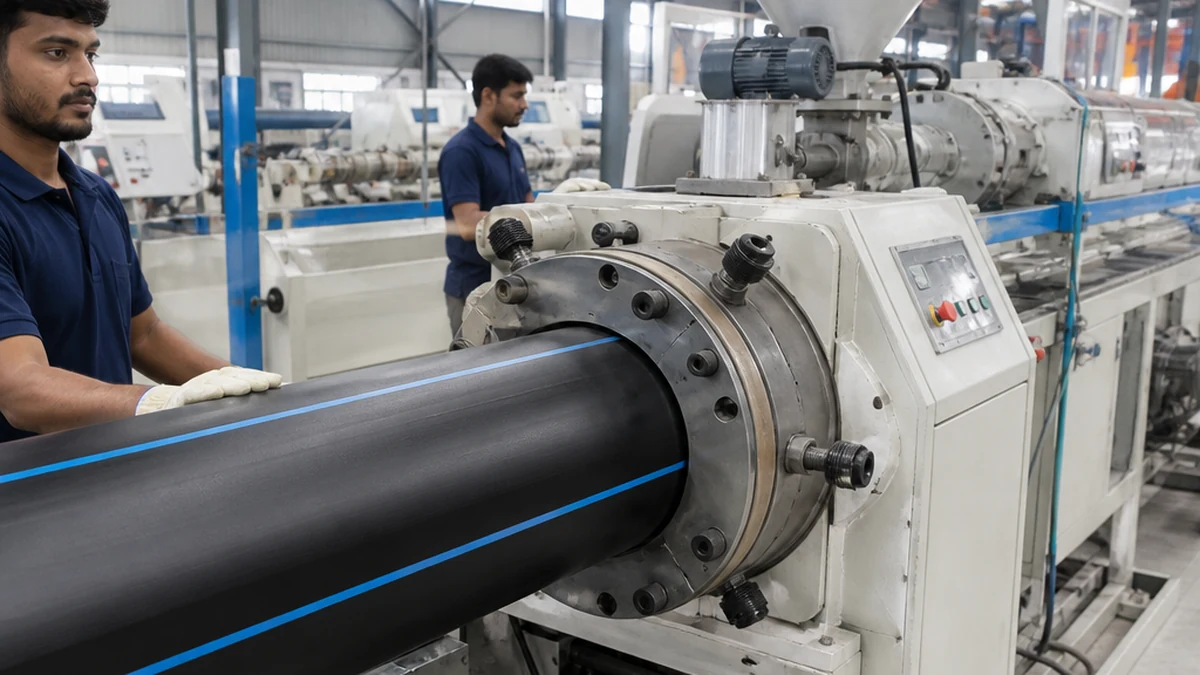
HDPE pipe extrusion machines are among the highest-volume exports from Indian plastic machinery manufacturers. A complete HDPE pipe making line (extruder, sizing tank, haul-off, cutting machine, coiler) for 20–110mm pipe at 100–150 kg/hr output runs $18,000–$45,000 USD FOB from experienced manufacturers. PVC pipe machines with vacuum calibration and multi-cavity dies occupy a similar range.
⚠️ Avertissement : Indian pipe extruder manufacturers sometimes quote “output” in kg/hr based on the screw’s theoretical displacement, not actual measured throughput with the die and downstream equipment running. Ask for witnessed factory acceptance tests (FAT) with your specified material and die configuration — not just the motor nameplate data.
Differentiation: specialty machine categories worth knowing
ABS/PMMA sanitaryware plate extrusion machines
Automatic ABS/PMMA sanitaryware plate extrusion machines represent a specialized segment where India has developed genuine manufacturing competence. These machines produce the acrylic-ABS composite sheet used in bathtub and shower tray manufacturing. The extrusion process requires co-extrusion of PMMA (top layer) over ABS substrate with precise layer thickness ratio control — typically 1.5–3mm PMMA over 4–8mm ABS.
Indian-built machines for this application run $45,000–$90,000 USD for a complete automatic line, and the key differentiator is the T-die lip adjustment system: manual lip bolts are adequate for single-color runs, but hydraulic automatic lip control is essential for consistent gloss and flatness in sanitary-grade output. When evaluating these machines, request melt pressure data and surface roughness test sheets from production runs — not just marketing photos.
Automatic 750 kg/hr PET/GPPS thick-plate extrusion lines
The automatic 750 kg/hr PET/GPPS thick plate extrusion line is a high-throughput machine plastic sheet producers use for industrial packaging trays, point-of-sale display material, and thermoforming feedstock.
At this output level, PET’s high hygroscopicity requires careful moisture management; while a vented or tandem screw configuration can reduce reliance on pre-drying, proper crystallizing pre-drying of PET resin — typically to below 50 ppm moisture — remains standard industry practice and should not be eliminated at this throughput.
Indian manufacturers building these lines typically pair a 120mm or 135mm screw extruder with a three-roll polishing stack and precision pull-roll assembly. Price range: $150,000–$190,000 USD FOB for a fully automatic line with automatic thickness gauge and edge trim recycling.
The critical spec to confirm is the polishing roll surface finish (Ra value) and temperature uniformity across the roll width — deviation beyond ±1°C at roll surface creates visible streaks in transparent sheet.
Tandem plastic extrusion lamination plants
A tandem plastic extrusion lamination plant combines two extruder machines in series — one for the primary substrate coating, one for the secondary lamination layer — and is used to produce multi-layer flexible packaging, liquid packaging board, and paper-poly laminates. This configuration allows different polymer materials to be applied in separate zones without co-extrusion die complexity. Indian tandem lamination plant manufacturers have supplied lines to U.S. converters at $80,000–$160,000 USD for configurations running 150–300 m/min web speed. The process control challenge is die gap synchronization between the two extruder stations — ask for PLC architecture details and whether the control system supports remote diagnostics, which matters significantly for post-installation support across time zones.
📝 Note: Chart values represent mid-points of typical FOB price ranges observed across Indian plastic machinery manufacturer quotations; individual configurations vary significantly based on screw diameter, output capacity, automation grade, and die tooling specifications.
Is plastic extrusion expensive? Understanding what drives cost
Yes and no. The machine itself is often a fraction of total project cost when you account for installation, commissioning, tooling changes, and the first year of spare parts inventory.
The real cost drivers:
- Die tooling — a precision HDPE pipe die for a specific diameter range costs $4,000–$15,000 USD separately from the extruder machine price; multi-cavity blown film dies run higher
- Downstream equipment — haul-off units, cutting machines, coilers, and stackers are often quoted separately and can add 30–60% to the base extruder price on a complete line
- Electrical standards compliance — Indian machines ship with IEC-standard electrical panels; rewiring to NEC/UL requirements for U.S. installation can add meaningful cost depending on panel complexity — confirm current estimates with a qualified U.S. electrical contractor before budgeting
- Freight and customs — ocean freight from India to a U.S. port varies with market conditions and should be confirmed with a licensed freight forwarder before budgeting; import duty rates on plastic extrusion machinery vary by HTS classification (observed rates have ranged widely depending on specific machinery type and classification), and verification directly with U.S. Customs and Border Protection or a licensed customs broker is appropriate due to classification specificity and the possibility of changing rates [2]
- Commissioning travel — if you need the manufacturer’s engineer on-site for startup, budget $3,000–$6,000 USD for airfare, per diem, and technical day rates
💡 Conseil de pro : For a complete plastic extrusion line, request an itemized quotation that separates the extruder machine, downstream equipment, die tooling, electrical panel, and commissioning support. A single bundled price makes it impossible to compare suppliers accurately or identify where cost reduction is feasible.
Who manufactures plastic extruder machines in India?
The Indian plastic machinery manufacturing sector is concentrated in Gujarat (particularly Ahmedabad and Rajkot), with secondary clusters in Maharashtra and Tamil Nadu. Indian manufacturers operate primarily in Gujarat, Maharashtra, and Tamil Nadu, spanning hundreds of companies from large established exporters to smaller specialized manufacturers.
Vrundavan Plastic Engineering Works has built a focused product range around blown film extrusion machines and dana making (plastic granules) lines. Their semi-automatic grade machines are commonly specified by U.S. buyers starting a recycled plastic granules operation or a simple PE bag making line where budget is the primary constraint. Lead times from Vrundavan run 45–60 days for standard configurations.
Nilkanth Engitech Private Limited concentrates on PVC pipe machine and HDPE pipe extruder lines. Their automatic grade machines ship with Siemens or Allen-Bradley PLC controls as an option — a meaningful advantage for U.S. plants where maintenance staff are already trained on those platforms, reducing the learning curve on process control.
Vital Force Engineering addresses the industrial end of the market, including multi-layer blown film plants and specialty extrusion lines. Their machines typically carry CE certification and are designed with export markets explicitly in mind — documentation, electrical panel configuration, and spare parts availability reflect that orientation.
⚠️ Avertissement : A significant number of Indian plastic machinery listings on B2B marketplaces are from trading companies, not manufacturers. Always verify whether you’re dealing with a factory directly. Ask for the GST registration number and cross-reference the registered business name against the machinery invoice address. A mismatch is a red flag.
Common mistakes buyers make
1. Comparing extruder machines on motor horsepower alone. Two machines with the same 75 HP drive can have completely different output because screw geometry, compression ratio, and barrel heating zone configuration determine actual plastic throughput. Compare specific output in kg/hr per screw diameter at your target melt temperature.
2. Ordering without a confirmed die specification. The extruder machine and the die are a matched system. An HDPE pipe extruder quoted without specifying the pipe diameter range and wall thickness tolerance will arrive with a die that may not meet your production spec. Lock the die geometry before you sign the purchase order.
3. Ignoring downstream equipment lead times. A cutting machine or coiler ordered separately from a different supplier can delay your complete line startup by 4–8 weeks. Either source the complete line from one manufacturer or confirm all equipment ships on the same vessel.
4. Skipping a witnessed FAT. Factory acceptance testing in the manufacturer’s facility, with your material or an agreed reference resin, is the only reliable way to validate output, surface finish, and dimensional consistency before the machine leaves India. The cost of a trip is trivial relative to the cost of receiving a machine that doesn’t perform.
5. Treating used plastic extruder machines as equivalent to new. The market for used plastic extruder machine for sale in India is active, and prices can look attractive — 40–60% of new machine cost. But wear on screw and barrel is invisible until you run production. Require dimensional inspection reports on screw OD, barrel bore, and flight land clearance.
Excessive clearance on a worn screw-barrel pair means you’re buying a rebuild project, not a production machine — consult your equipment engineer or the manufacturer for acceptable tolerance thresholds for your specific application.
How to evaluate Indian plastic extruder machine suppliers
Before issuing a purchase order, work through this checklist:
- ISO 9001:2015 certificate — quality management system certification can be an indicator of manufacturing process discipline; confirm with the certifying body that any certificate presented is current and covers the relevant scope of manufacturing activity, as the scope and validity of such certificates should be independently verified [1]
- CE Declaration of Conformity — required if the machine will be re-exported to EU/EEA markets; CE marking is an EU/EEA market-access requirement and is not a U.S. domestic legal requirement
- Reference list — ask for 3 current customers in your machine category who you can contact directly; a serious manufacturer provides this without hesitation
- Spare parts commitment — confirm the manufacturer can supply critical wear parts (screw, barrel liner, heater bands, gearbox seals) for a minimum of 10 years, and that they maintain U.S.-based stock or an authorized distributor
- Remote support capability — modern plastic extruder machines should support remote PLC access for troubleshooting; confirm whether this is standard or an add-on option
At MQ Extrusion, our engineers have substantial direct experience in plastic machinery development and have worked with extrusion machine specifications and selection guide customers across more than 40 countries on extrusion line specifications.
A mistake we see on most first sourcing projects from India is that buyers receive a machine that’s correctly built but incorrectly specified — the screw design was optimized for a different resin family than the buyer actually runs. That disconnect is preventable with the right specification conversation before the order is placed.
For buyers ready to move from evaluation to action: request itemized quotations from at least three manufacturers with your full production specification — material, output rate, product dimensions, and automation requirements — then compare on total landed cost, not extruder machine price in India alone. The plastic extrusion line inquiry and quotation process process takes less time than a return shipment.
Vous avez un projet ou un cahier des charges ? Contactez mqextrusion.com : ce sont de vrais ingénieurs qui vous répondront.
FAQ
How much does a plastic extruder machine cost?
Plastic extruder machine prices in India range from roughly $3,000 to $150,000 USD depending on screw diameter, output capacity, and automation level. Entry-level single-screw units for simple profiles start at $3,000–$8,000 USD FOB, while twin-screw compounding lines or high-output pipe extrusion systems push toward six figures. U.S. importers must add ocean freight, customs duties, and commissioning costs, which typically add 15 to 25 percent to the ex-works India price.
How much does an extruder cost?
A basic lab-scale or small production extruder sourced from India can cost $3,000 to $20,000 USD ex-works. Mid-range production extruders with variable speed drives and digital controls fall between $18,000 and $80,000. Heavy-duty twin-screw or co-extrusion systems built for continuous U.S. production runs commonly exceed $100,000 once landed and installed. Always request a landed cost breakdown before comparing quotes from different Indian suppliers.
Is plastic extrusion expensive?
Plastic extrusion is capital-intensive upfront but cost-efficient at scale. Sourcing the machine from India can reduce equipment acquisition cost by 30 to 60 percent compared to equivalent U.S.- or European-built machinery. Ongoing costs — resin, energy, operator labor, and maintenance — largely determine total cost of ownership. U.S. buyers who underspecify screw geometry or barrel hardness to cut purchase price often face premature wear, unplanned downtime, and repair costs that eliminate the original savings.
Who are some manufacturers of plastic extruders?
India has several well-regarded extruder manufacturers that export to the United States, including Windsor Machines, Kabra Extrusiontechnik, and Steer Engineering. These companies produce single-screw, twin-screw, and co-extrusion lines that meet international standards. U.S. sourcing teams should verify CE or UL compliance requirements for their facility, request factory audit reports, and confirm that the manufacturer provides English-language documentation, spare parts availability in the U.S., and remote technical support.
Sources
[1] What ISO 9001:2015 actually covers when you order metal… — nevatronix.com
[2] 8477.90.86.01 — hts.usitc.gov
[3] Plastic Extrusion Machines Manufacturers, Suppliers … — tradeindia.com
[4] Plastic Extrusion Machines – Plastic Extruder Latest Price, … — dir.indiamart.com
[5] Extruder Machine — shreetuljaindustries.com
[6] Top Plastic Extruder Machine Manufacturers in Ahmedabad — justdial.com