Plastic Extruder Price: What U.S. Buyers Actually Pay in 2026
Buyers who fixate on the sticker price typically overpay by 20–40% on total installed cost — or underspend on capacity and buy twice. If you’re sourcing a plastic extruder for a U.S.
production line, prototype lab, or toll-processing facility, the decision hinges on three variables the spec sheet never leads with: screw diameter relative to your output rate, the support infrastructure behind the machine, and whether new or pre-owned makes economic sense for your throughput. This guide helps you think through all three before you issue an RFQ — and explains how Arlington Plastics Machinery approaches each decision with buyers.
Plastic Extruder Price at a Glance
| Item | Detail |
|---|---|
| Benchtop / lab (single-screw, ≤25 mm) | $5,000–$30,000 new; $2,500–$12,000 used |
| Mid-range single-screw (30–90 mm) | $25,000–$120,000 new; $10,000–$50,000 used |
| Twin-screw compounding (co-rotating, 35–75 mm) | $80,000–$400,000+ new; $30,000–$160,000 used |
| High-output production line (pipe, sheet, profile) | $150,000–$800,000+ full line |
| Used / rebuilt extruders for sale | 30–60% of equivalent new price |
| Delivery lead time (new) | 12–24 weeks from confirmed order |
| Key standards to confirm | UL electrical certification, OSHA guarding standards[1], NEC code compliance for domestic wiring |
How Much Does a Plastic Extrusion Machine Cost?
The honest answer: plastic extruder price spans nearly three orders of magnitude — from a $6,000 single-screw desktop unit to a $700,000+ co-rotating twin-screw compounding line with downstream pelletizer and controls cabinet.
The biggest driver isn’t the extruder brand. It’s screw geometry and diameter. A 45 mm single-screw extruder at 200 rpm delivers roughly 150–250 lb/hr on polyethylene, according to standard output rate data[2]. Doubling to a 90 mm unit at the same rpm pushes 900–1,200 lb/hr. That capacity jump — roughly 4–5× — also multiplies cost by about 3–4×.
Pin down your required output in lb/hr and your material’s melt viscosity before you call any supplier. Those two numbers narrow the viable diameter range and immediately bracket your plastic extruder price.
Controls add more than buyers expect. A basic temperature controller and manual speed dial might cost $2,000 on a simple extruder. A full Allen-Bradley PLC panel with touchscreen HMI, recipe management, and remote diagnostics can add $15,000–$40,000 to the same machine frame. For a regulated application like medical tubing or food-contact packaging, that’s a compliance requirement, not overhead.
📝 Remarque : Quoted plastic extruder price almost never includes the die, downstream cooling, haul-off, and cutting equipment. Budget 40–80% of the base extrusion machine cost again for a functional line.
New vs. Used Extruder: The Price Gap That Surprises Most Buyers
This is where first-time buyers most often leave money on the table.
A 2.5-inch (63 mm) single-screw extrusion machine from a recognized U.S.-compatible manufacturer runs $45,000–$75,000 new with standard controls. A rebuilt unit of equivalent diameter and screw geometry from Arlington Plastics Machinery — rebuilt barrel and screw, new heater bands, remanufactured gearbox — typically prices at $18,000–$35,000.
That’s not a small delta.
The right question isn’t “new or used?” — it’s “what’s the rebuild scope, and who backs it?”
A used extruder sold as-is carries real risk: worn screw flight clearances reduce output by 15–30% before any visible symptom shows. A properly rebuilt machine should come with documented barrel-to-screw clearance measurements, a test run report at rated speed and temperature, and at least a 90-day parts warranty. Ask for all three in writing before you wire a deposit.
Counterintuitively, the pre-owned machines Arlington sees last longest are often the heavier-cast units from the 1990s — they were overbuilt by today’s standards, and that rigidity pays off over decades of production.
Customers in R&D labs and specialty compounding operations have run rebuilt machines through multiple production cycles before needing a second rebuild. The economics are compelling when your throughput doesn’t justify amortizing a new machine purchase.
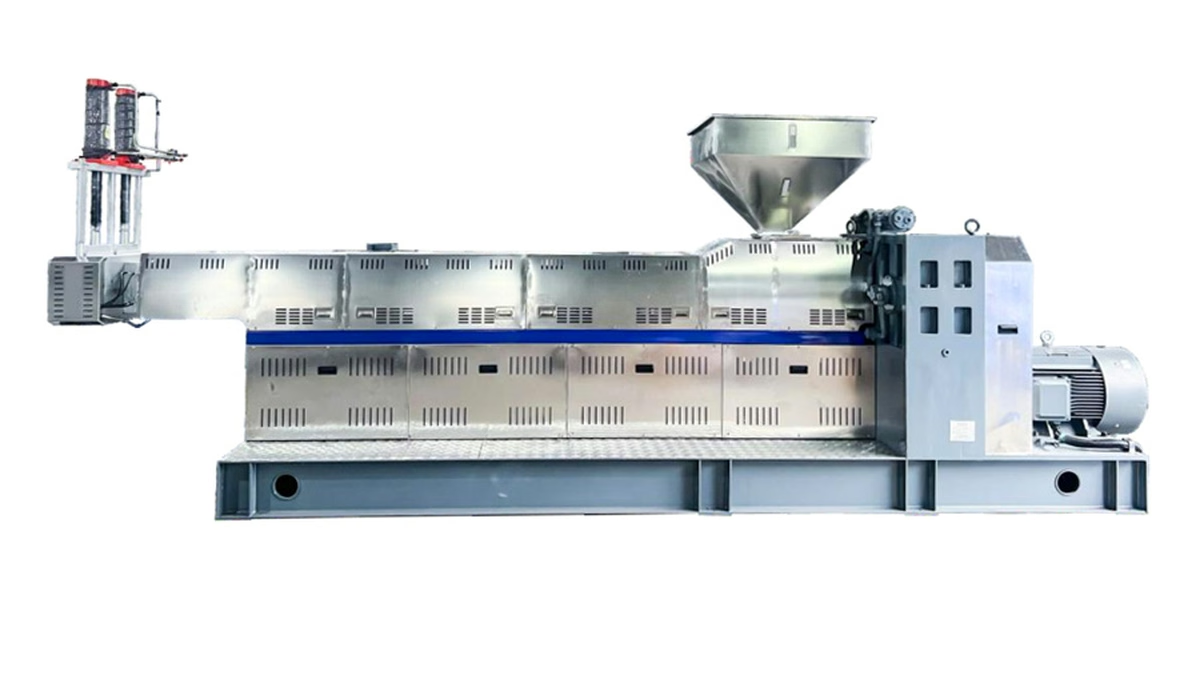
What Drives Plastic Extruder Machine Price — 5 Real Levers
1. Screw Design and L/D Ratio
Longer screws relative to diameter (expressed as L/D ratio) give more residence time and mixing. A standard pipe extrusion machine might run L/D 24:1. A high-mixing compounding unit runs 36:1 or higher. Each increment in L/D adds machining cost, barrel length, and heater zones — directly raising the plastic extruder price. Don’t spec a higher L/D than your material actually requires; you’ll pay for capability you won’t use.
2. Material Compatibility
Running abrasive-filled compounds (glass fiber, mineral) or corrosive polymers (PVC, fluoropolymers) requires bimetallic barrel lining[3] and hardened screw alloys. That upgrade adds $8,000–$25,000 over a standard nitrided barrel, depending on diameter. Buyers processing commodity polyolefins who spec bimetallic barrels are over-buying. Buyers who skip it on glass-filled nylon are guaranteeing a $20,000 barrel replacement in 18 months.
3. Drive System
AC vector drives with encoder feedback hold speed within ±0.1 rpm and protect the screw from torque spikes. Older DC drive systems are cheaper up front but carry higher long-term maintenance costs — replacement DC motor components are increasingly scarce in the U.S. supply chain, per industry maintenance data[4]. On any extrusion machine you expect to run continuously, the drive upgrade pays back quickly.
4. OEM vs. Assembled-in-USA vs. Imported
A machine assembled in the U.S. with domestic electrical components commands a 20–35% premium over a functionally equivalent imported extruder. That premium is partly justified: domestic wiring meets NEC code[5] out of the box, UL-listed components[6] don’t require field rework, and local service techs can work on it without an ocean crossing for parts.
For a production environment running two shifts, that’s real value. For a lab machine running 200 hours a year, it may not be.
5. Downstream and Auxiliary Equipment
The extruder is the engine; the line is the car. A 60 mm extrusion machine priced at $55,000 needs a die ($3,000–$40,000 depending on complexity), a cooling tank ($8,000–$20,000), a haul-off/puller ($5,000–$18,000), and a cutter or winder ($4,000–$30,000). Factor the full line cost before you allocate budget.
| Extruder type | New price range | Used/rebuilt range |
|---|---|---|
| Single-screw, ≤25 mm (lab) | $5,000–$30,000 | $2,500–$12,000 |
| Single-screw, 45–75 mm | $40,000–$110,000 | $15,000–$45,000 |
| Single-screw, 90–150 mm | $90,000–$200,000 | $35,000–$90,000 |
| Twin-screw (co-rotating) | $80,000–$400,000+ | $30,000–$160,000 |
| Twin-screw (counter-rotating) | $60,000–$250,000 | $25,000–$100,000 |
How Much Does a Filament Extruder Cost?
Filament extruders — designed to produce 1.75 mm or 2.85 mm diameter 3D printing filament to tight tolerances — occupy a distinct sub-category. A benchtop filament extruder starts around $5,000–$10,000 for a hobbyist-grade unit. A production-grade filament line capable of holding ±0.02 mm diameter tolerance[7] at 5–10 kg/hr output runs $30,000–$80,000 for the full line (extruder, die, laser gauge, cooling, winder).
The critical spec for filament is diameter consistency, not throughput. A cheap extrusion machine that swings ±0.1 mm in diameter produces filament that jams print heads. If you’re evaluating plastic extruder price for filament specifically, ask for a diameter tolerance guarantee and a documented test run — not just a machine spec sheet.
Used Extruders for Sale — Arlington Plastics Machinery’s Inventory and Approach
Arlington Plastics Machinery maintains a standing inventory of single-screw and twin-screw extrusion equipment sourced from U.S. compounders, processors, and manufacturers who have upgraded, downsized, or closed. That sourcing model means the machines Arlington lists have a domestic production history — wiring is already NEC-compliant, voltage is matched to U.S. facilities, and the wear history is traceable rather than unknown.
Every used extruder for sale through Arlington goes through a documented condition assessment before listing. That assessment covers screw-to-barrel clearance measurements (the single most predictive indicator of remaining output capacity), gearbox bearing condition, heater band resistance readings, and drive system function under load. If a machine doesn’t pass that review, Arlington either rebuilds it to spec or parts it out rather than selling a marginal unit into a production environment.
Lead times on in-stock used extrusion equipment from Arlington typically run 2–6 weeks — versus 12–24 weeks for a new machine built to order. That difference matters when you have a production gap, a line expansion, or a machine down.
For buyers who need a fully rebuilt unit rather than an inspected-as-is machine, Arlington offers a rebuild scope covering new barrel liner or replacement barrel, remetallized or new screw, remanufactured gearbox with new bearings, new heater bands and thermocouples, and a full test run at rated speed before shipment. Rebuilt units carry a documented warranty covering parts and workmanship — ask for the specific terms in writing before committing.
💡 Conseil de pro : When evaluating any used extruder for sale, request the screw-to-barrel clearance measurement report. Clearances above 0.008 inch on a single-screw unit signal worn components that will cut output and raise melt temperature — problems that don’t show up on a quoted plastic extruder price.
Why Buy a Used Extruder? The Economic Case Is Stronger Than It Looks
The argument for buying new is clear: warranty, current technology, domestic support. But the case for a quality pre-owned extrusion machine is more compelling than most buyers assume when they first start sourcing.
A properly rebuilt unit represents a machine that has already shaken out manufacturing tolerances and whose wear points are known quantities. The original barrel has been replaced or relined. The screw has been inspected and remetallized or replaced. The gearbox has been rebuilt with new bearings.
What you’re buying is the mechanical structure — often a heavier, more rigid casting than equivalently priced new imports — paired with freshened wear components.
The economics are straightforward. A rebuilt 63 mm single-screw at $22,000 vs. a new equivalent at $60,000 leaves $38,000 that can fund downstream equipment, a spare screw set, or a second line. That capital reallocation changes the production math for small and mid-size processors.
One more real consideration: used equipment allows a processor to trial a new product line or material without committing to new-machine capital. If the application proves out, you upgrade. If it doesn’t, you haven’t written down a $90,000 asset.
Industries Arlington Plastics Machinery Serves
The used extrusion equipment market touches nearly every polymer-processing vertical in the U.S., and Arlington’s inventory reflects that breadth.
Pipe and conduit manufacturers are among the most consistent buyers — HDPE pipe for municipal water and gas distribution, PVC conduit for electrical contractors, and corrugated HDPE for drainage applications all run on extrusion equipment that Arlington regularly stocks.
A 90 mm or 120 mm single-screw unit with a vacuum sizing tank is the core of a pipe line, and pre-owned machines in this class are frequently available at 40–55% of new cost.
Specialty compounders running short campaigns on engineering polymers, masterbatch, or filled compounds are strong candidates for twin-screw extrusion equipment from Arlington’s inventory. A co-rotating twin-screw in the 35–52 mm range handles most compounding work; Arlington typically carries several units in this class.
Packaging film and sheet processors — converting polyethylene, polypropylene, or PET into film, barrier sheet, or thermoforming stock — use single-screw extrusion machines in the 60–120 mm range. These lines run high hours and turn over regularly in the secondary market.
Medical device and tubing manufacturers need tight-tolerance extrusion equipment with validated controls and full documentation. Arlington can source and certify equipment for these applications, including machines with existing FDA-compliant documentation packages where available.
University and corporate R&D labs routinely need a functional extruder without capitalizing a new machine. A lab-scale single-screw in the 19–38 mm range, sourced used through Arlington, can cut equipment cost by 50–60% while still delivering the output consistency a research program requires.
Automotive and construction profiles — window lineals, trim, weatherstrip, deck board — run on profile dies matched to single or twin-screw extrusion machines. Arlington’s inventory across these verticals means a processor adding a parallel line doesn’t need to wait 20 weeks for delivery.
Why Choose Arlington Plastics Machinery?
There are dozens of used equipment dealers in the U.S. plastics market. The distinction with Arlington is specific, not generic.
First, Arlington’s inventory is sourced and assessed domestically. The machines listed were running in U.S. plants, wired to U.S. standards, and their production history is documented — not estimated from an import manifest.
Second, Arlington’s pre-sale inspection process produces documentation that buyers can act on. Clearance measurements, gearbox condition reports, and test run data aren’t marketing language — they’re the basis on which a buyer can make a capital decision with confidence.
Third, Arlington’s team works with buyers at the specification stage. The single most common mistake in used equipment purchases is buying the wrong machine for the application — wrong diameter for the target output, wrong barrel material for the compound, wrong drive for the duty cycle. Arlington’s application review before purchase prevents that. It’s not upselling; it’s the conversation that makes the machine perform after delivery.
Finally, Arlington buys as well as sells. If your operation is upgrading, downsizing, or closing, Arlington provides equipment valuations and acquisition for single machines or complete lines. That two-way market relationship is part of what keeps Arlington’s inventory current and priced realistically.
5 Costly Mistakes Buyers Make on Plastic Extruder Price
- Buying on per-kg output price without checking motor torque rating. A machine rated for 200 lb/hr on polyethylene may deliver only 120 lb/hr on a high-viscosity engineering polymer. Always ask for a torque curve, not just an output number.
- Ignoring spare parts availability. An extrusion machine priced 15% lower because it uses proprietary heater bands or non-standard barrel dimensions will cost that difference back on the first unplanned repair. Confirm that barrels, screws, heater bands, and thermocouples are available from at least two U.S. suppliers.
- Treating tooling as an afterthought. The die is as important as the extruder. A poorly designed die creates thickness variation that no extruder adjustment can fully correct. Budget for die design review — a $1,500 engineering consultation before die fabrication is cheaper than a $12,000 die re-cut.
- Not specifying voltage and phase upfront. Imported equipment often ships wired for 380V/3-phase. U.S. facilities run 460V/3-phase (or 208V in some older plants). Transformer costs and installation delays from a voltage mismatch have derailed more than one timeline.
- Skipping a factory acceptance test. For any extrusion machine over $50,000, insist on an FAT at rated throughput and temperature before shipment. Discovering a gearbox vibration after the machine is bolted to your floor is an expensive lesson.
Work With Arlington Plastics Machinery — Buy or Sell
Buying: Arlington’s process starts with your throughput target, material data sheet, and facility electrical specs. From there, the team identifies in-stock units that match the application or scopes a rebuild to your requirements. You receive a condition report, a quoted plastic extruder price with rebuild scope if applicable, and a delivery timeline — before you commit.
Selling: Arlington buys used extrusion equipment outright. If your operation is replacing a line, closing a facility, or right-sizing capacity, Arlington provides a market-based valuation and can move quickly on acquisition. Complete lines, individual extruders, and auxiliary equipment are all within scope.
The right conversation starts with what you’re running — not with a catalog. Reach out to Arlington Plastics Machinery with your application details, and you’ll get a direct answer on whether used, rebuilt, or new extrusion equipment makes sense for your budget and timeline. For buyers also evaluating lab-scale extrusion options, the same process applies — application first, then equipment.
That directness is what buyers in specialty compounding and industrial extrusion applications keep coming back for.
Résumé rapide généré par l'IA
What it is
A plastic extruder price is the capital cost of a screw-and-barrel machine that continuously melts and shapes thermoplastic resin. In the United States, prices span from roughly $5,000 for a benchtop lab unit to over $800,000 for a full high-output production line, with new-to-used price ratios typically ranging from 1.7× to 3.3× depending on rebuild scope.
Numbers to know
- A 45 mm single-screw extruder at 200 rpm yields approximately 150–250 lb/hr on polyethylene; a 90 mm unit at the same rpm yields 900–1,200 lb/hr — a 4–5× capacity jump that raises machine cost by roughly 3–4×.
- Used and rebuilt extruders sell for 30–60% of equivalent new price.
- A full Allen-Bradley PLC panel with touchscreen HMI and remote diagnostics adds $15,000–$40,000 to the base machine frame.
- Downstream equipment — die, cooling, haul-off, cutting — adds another 40–80% of the base extrusion machine cost to reach a functional line.
- Bimetallic barrel lining for abrasive or corrosive polymers adds $8,000–$25,000 over a standard nitrided barrel, depending on screw diameter.
Rules of thumb
- Nail down required output in lb/hr and material melt viscosity before requesting quotes — those two numbers bracket screw diameter and immediately narrow the viable price range.
- If a rebuilt unit lacks documented barrel-to-screw clearance measurements, a test-run report at rated speed and temperature, and a written 90-day parts warranty, do not issue a deposit.
- Worn screw flight clearances reduce output 15–30% before any visible symptom appears — always request clearance data on any used machine.
- Avoid specifying a higher L/D ratio than your material requires; every additional L/D increment adds heater zones, machining cost, and barrel length with no production benefit.
- Buyers processing commodity polyolefins do not need bimetallic barrels; buyers running glass-filled or fluoropolymer compounds who skip bimetallic lining face a costly premature barrel replacement.
Vous avez un projet ou un cahier des charges ? Contactez mqextrusion.com : ce sont de vrais ingénieurs qui vous répondront.
FAQ
How much does an extruder cost?
A plastic extruder in the United States ranges from roughly $10,000 for a basic single-screw lab unit to over $500,000 for a high-output twin-screw production line. For example, a rebuilt 63 mm single-screw runs around $22,000 versus $60,000 for a new equivalent. Total installed cost adds 20 to 40 percent once you factor in the die, downstream cooling and haul-off equipment, controls, and installation. Buying used can cut capital outlay by 30 to 50 percent but introduces rebuild and lead-time risk.
Is plastic extrusion expensive?
Relative to injection molding, plastic extrusion carries lower tooling costs because a die is far cheaper than a mold. The machine itself is the main capital expense. For continuous profiles, pipe, or sheet, extrusion is one of the most cost-efficient plastic processing methods available. High-barrier or precision applications requiring co-extrusion or tight tolerances push costs up significantly. Whether it is expensive depends entirely on run volumes, resin costs, and how well the line capacity matches your actual throughput needs.
How much does a filament extruder cost?
Desktop or benchtop filament extruders for research and recycling start around $2,000 to $8,000. Semi-industrial units capable of consistent diameter tolerances for 3D printing filament production run $15,000 to $60,000. Production-scale filament lines with spooling, laser diameter gauging, and full process controls typically cost $80,000 to $200,000 or more. Tolerance consistency, not throughput, is the spec that separates price tiers in this segment.
Sources
[1] 1910.212 – General requirements for all machines. — osha.gov
[2] Extrusion basics: To optimize output, run smarter, not faster — plasticstoday.com
[3] Bimetallic vs Nitrided Barrel: Which One Should You Choose? — extruder-parts.com
[4] Why switching to AC drives for plastic extrusion makes sense — new.abb.com
[5] NFPA 70 (NEC) Code Development — nfpa.org
[6] Certification — ul.com
[7] Effects of Filament Diameter Tolerances in Fused… — researchgate.net