Qu'est-ce qu'un matériau composite thermoplastique (TPC) destiné à l'aérospatiale ?
Aerospace thermoplastic composite material
In the aerospace field, commonly used thermoplastic composite matrix materials include polyetherimide (PEI), polyetheretherketone (PEEK), polyetherketone ketone (PEKK), low-melting-point polyaryletherketone (LMPAEK), polyphenylene sulfide (PPS), ABS, etc. These materials are usually reinforced with glass fiber (GF) or carbon fiber (CF).
Thermoplastic composite materials (TPC) have been widely used in civil aviation manufacturing, defense and military equipment, space exploration, and related scientific research projects in the aerospace field.
At present, commercial aviation applications occupy an important share in the industry and continuously expand the application scope of TPC through continuous research and development efforts.
A market study in 2019 showed that the market size of thermoplastic composite materials for the aerospace and defense industries is expected to reach 636.5 million US dollars, reflecting the increasing attention paid to this material.
Since the 1980s, the application of TPC in the aerospace field has continued to expand, with its scope constantly expanding. Figure 1 shows several key application examples of TPC in the aerospace and defense industries. For example, the J-nose component based on CF-PPS developed for Airbus laid the foundation for the application of TPC in commercial aviation.
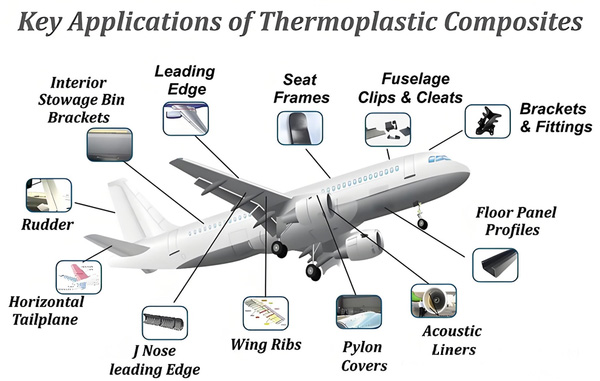
Figure 1: Key Applications of Thermoplastic Composite Materials in the Aerospace Field
Thermoplastic composite materials are widely used in structural and non-structural components of aircraft. Since the 1990s, TPC has been applied to key components such as ribs and wing beams of landing gear doors. As a major user, Airbus uses thermoplastic skins, panels, and leading-edge components in the A340-600 and A380 models.
In addition, TPC is widely used in small components such as clips, clamps, brackets, and floors in commercial aircraft, jets, and military helicopters. The Gulfstream G650 aircraft’s use of TPC-manufactured rudder and tail fins is a typical example.
Common thermoplastic interior components include seat chassis, backrests, trays, and seat frames. The production of side walls and ceiling connecting rails in Airbus A330 and A340 is a typical case of cabin application. Common components made of TPC include ribs, brackets, and reinforcing ribs.
3D Printing technology
3D printing technology brings new application possibilities to the aerospace industry. Currently, multiple aerospace companies are testing and using 3D printed thermoplastic components, fully utilizing their fast and precise production advantages. For example, Boeing has applied 3D printed parts in the 737, 747, 777, and 787 Dreamliner series, and the 787 model alone has achieved $3 million in revenue. This technology is particularly suitable for quickly and accurately manufacturing parts with complex geometric shapes. The Airbus A350 XWB aircraft uses over a thousand PEI-based 3D printed components, paving the way for the application of 3D printing technology in large aircraft and future aviation projects. With its fast, lightweight, durable, and high-precision characteristics, it gradually replaces traditional materials and processes.
Multiple aerospace companies use different thermoplastic processing techniques to manufacture large and small rocket components. For example, in the ATEK project [4], the German Aerospace Center replaced the aluminum-based main structure with in-situ manufactured CF-PEEK composite materials and used them for sounding rocket test components. The project aims to develop reusable and recyclable spacecraft components to reduce production costs. Please refer to the figure for relevant research.
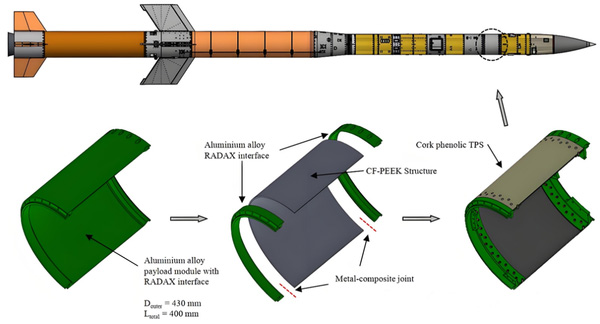
Image: Rocket used in ATEK program and original aluminum components replaced by CF-PEEK thermoplastic composite materials.
Airbus launched the “Wings of Tomorrow” (WOT) project in 2015, collaborating with multiple aerospace companies to develop new production processes that utilize new materials to manufacture economically efficient aircraft wings. Under the WOT framework, GKN Aerospace has developed thermoplastic composite rib materials, whose performance is comparable to aluminum or thermosetting composite materials, and has improved corrosion resistance while reducing weight.
Multiple European airlines and institutions have collaborated to promote the development and application of thermoplastic composite materials (TPC) in the aerospace industry. The “Thermoplastic Economy Aircraft Main Structure Alliance” (TAPAS) project is divided into two stages: TAPAS1 and TAPAS2.
The Netherlands first launched the TAPAS project in 2009 and continued until 2017, bringing together multiple aviation companies and institutions to jointly promote the research and development of new TPC components. The TAPAS1 project has completed the manufacturing of demonstration components, body, and torque box; TAPAS2 has developed a new torque box and body technology. At present, these projects are being coordinated under the “Clean Sky” program to further improve technical solutions and expand the scope of cooperation.
Clean Sky (2008-2016) and Clean Sky 2 (2017-2021) are important components of the EU’s Horizon 2020 program. One of the most important achievements in “Clean Sky 2” is the launch of a multifunctional fuselage demonstrator made of thermoplastic composite materials to reduce costs and weight, which is intended for use in cabin systems. The planned aircraft structure is shown in the diagram.
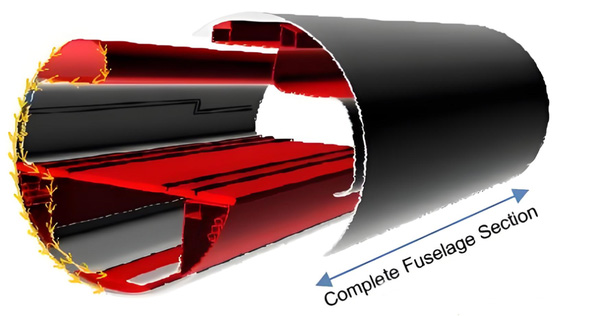
Image: Thermoplastic composite material fuselage section
PEKK and LMPAEK aerospace applications
Looking back at the experiments and research in the aviation field, PEEK, PEKK, and LMPAEK in the polyaryletherketone (PAEK) family of materials are the most widely used and have the strongest applicability. For example, in the TAPAS2 project, GKN Fokker launched the “Docking Orthogonal Grid Technology” to achieve cost-effective manufacturing of thermoplastic composite body materials.
Another important application is the use of online ultrasonic spot welding technology to connect CF/PEEK hinges, CF/PEEK clips, and CF/PEEK C-frames into a demonstration sample, which belongs to the “Clean Sky” ecological design project [9]. Research has shown that different materials can be selected and integrated into the same product according to actual needs.
PEKK is not only suitable for aerospace, but also has broad prospects in space structures. Lockheed Martin Space Company is developing the next generation of 3D printed thermoplastic components for NASA’s Orion spacecraft and conducting related research and development projects.
In order to improve production efficiency and aircraft manufacturing speed, the aerospace industry continuously innovates the design and manufacturing processes of aircraft structures. Among them, the use of PEEK for encapsulation molding is a representative technology. For example, the PEEK grid reinforced demonstration board shown in the figure combines compression molding and injection molding processes to achieve the high performance of continuous fiber composite materials with the geometric stiffness of injection molded grids. The entire molding cycle is less than two minutes, significantly saving time.
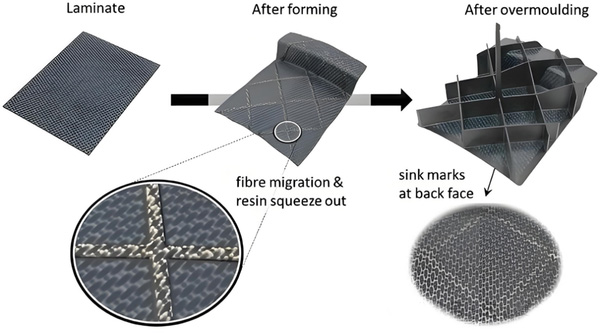
Image: CF/PEEK grid reinforcement demonstrator manufactured through encapsulation technology
LMPAEK was used as a unidirectional (UD) prepreg in the Clean Sky 2 large aircraft test project and was one of the first laminated panels manufactured in the 30-month project. LMPAEK was first introduced in the TAPAS1 project, and Airbus Nantes showcased a fuselage panel with integrated reinforcement ribs at the 2013 Paris Air Show. The panel was manufactured using CF/LMPAEK tape provided by TenCate and welded Omega and T-beams to the skin using the Automatic Fiber Placement (AFP) process. AFP、 Stamping and welding processes are particularly suitable for the processing of LMPAEK, which performs well in automated production such as automatic tape laying (ATL). Figure 11 shows a laminated board manufactured using ATL and compression molding processes.
PPS composite materials
Polyphenylene sulfide (PPS) composite materials are widely used in the aerospace and defense industries, and have been approved for use in circuit boards, sockets, plugs, electronic components, and anti-aircraft aircraft.
The common manufacturing processes of thermoplastic materials, such as thermoforming, compression molding, and injection molding, typically require high-temperature and high-pressure environments, while polyetherimide (PEI) has broad application prospects due to its high temperature resistance and stable mechanical properties. With the development of 3D printing technology, companies have made multiple breakthroughs in the aerospace field, providing new cases for related research. This technology can quickly manufacture high-quality prototypes, fixtures, and small batch parts. For example, Aurora Flight Sciences has collaborated with Stratasys to develop the world’s first 3D printed jet drone, with 80% of its common components printed using PEI-based materials. The overall design combines lightweight, high speed, and high production efficiency.
ABS composite materials
ABS is usually used as a lightweight alternative to traditional aerospace materials for applications that do not require high strength and high temperature resistance. By modification or blending with other materials, ABS can also be used to manufacture important components to achieve the desired performance. ABS and its mixed materials are commonly used in commercial aircraft cabin interiors due to their excellent chemical resistance and flame retardancy. ABS is an ideal choice for components that do not require extremely high structural strength but require lightweight, economical, durable, and easy maintenance. For example, CF/ABS thermoplastic composite sandwich structures have been used to manufacture double tilt fixtures for quadcopters, and tests have shown that their performance is superior to traditional single-piece structures.
TPC materials
Thermoplastic composite materials (TPC) are gradually becoming an important alternative to traditional materials in the aerospace industry due to their current advantages. Recyclable, easy-to-form, weldable, lightweight, and durable TPC materials have been an important research and application direction in this field for many years. In addition, 3D printing technology is particularly suitable for manufacturing thermoplastic composite components in unmanned aerial vehicles and other aerospace fields.
Meanwhile, thanks to its recyclability, TPC has significant potential for application in future aerospace projects. MQ is also committed to providing extrusion production lines for high-end materials, making high-performance materials even more outstanding.