Plastic Extruder Machine Price: What Drives the Cost in 2026
The assumption floating around most procurement conversations is that a plastic extruder machine price is mostly a function of size — bigger barrel, bigger bill. The reality is more nuanced. Configuration, screw geometry, downstream tooling, and the resin families the machine must handle can swing a quote by 300% at the same throughput rating. Size is one variable. It’s rarely the deciding one.
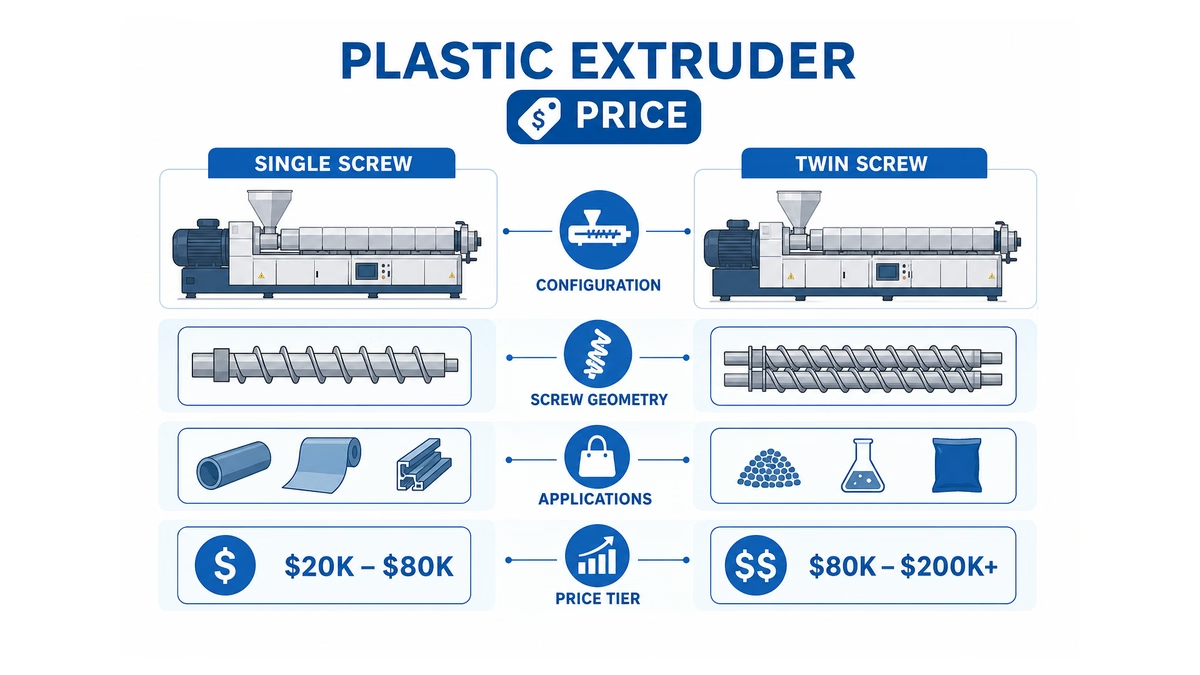
Here’s the honest frame: entry-level single screw extruders for simple polyethylene or PVC profiles start around $8,000–$18,000 FOB. Mid-range co-extrusion and twin screw lines for compounds or specialty film run $40,000–$150,000. Full turnkey production lines with downstream — pipe, blown film, strapping — routinely land at $180,000–$500,000+ depending on output diameter, layer count, and automation level. Those bands matter more than any single “average.”
At a Glance
- Entry single screw extruder (lab/small-batch): $8,000–$18,000
- Mid-range single screw line (pipe, profile, sheet): $20,000–$80,000
- Twin screw compounding extruder: $45,000–$200,000+
- Blown film extrusion line (mono or 3-layer): $30,000–$180,000
- Pipe extrusion line 20–630mm: $60,000–$350,000
- Stretch/cast film co-extrusion line: $80,000–$250,000
- Typical U.S. import lead time: Lead times vary and are subject to change; confirm current sea freight and air freight estimates with your freight forwarder at the time of order.
- Standard certifications to require: For U.S. installations, the relevant standards are UL 508A (for industrial control panel construction) and NFPA 79 (for electrical equipment on machinery). ISO 9001 is a widely recognized quality management standard. UL listing for control panels is industry-standard practice; confirm mandatory requirements with your local authority having jurisdiction.
- MOQ: most machinery manufacturers quote per-unit; min order quantity = 1 machine, though tooling sets (dies, calibrators) may require 2–3 set minimum
How Much Does a Plastic Extrusion Machine Cost?
The cost of an extrusion machine scales with three compounding factors: screw type, output specification, and downstream integration. A standalone single screw extruder barrel and drive is a fraction of what a complete plastic extrusion production line costs once you add the die head, vacuum calibration tank, haul-off, cutter, and control system.
Our team has quoted U.S. buyers across all three tiers, and the single most consistent mistake we see on first orders is requesting a machine price without specifying the full line scope. A pipe extrusion line quoted “machine only” versus “turnkey 20–110mm HDPE line ready to run” can differ by $90,000 on the same screw diameter.
📝 Remarque : Always request a line-scope quotation — itemized for extruder, die head, downstream, and electrical panel — before comparing supplier quotes. Apples-to-apples comparison is impossible otherwise.
How a Plastic Extruder Works — and Why It Affects Price
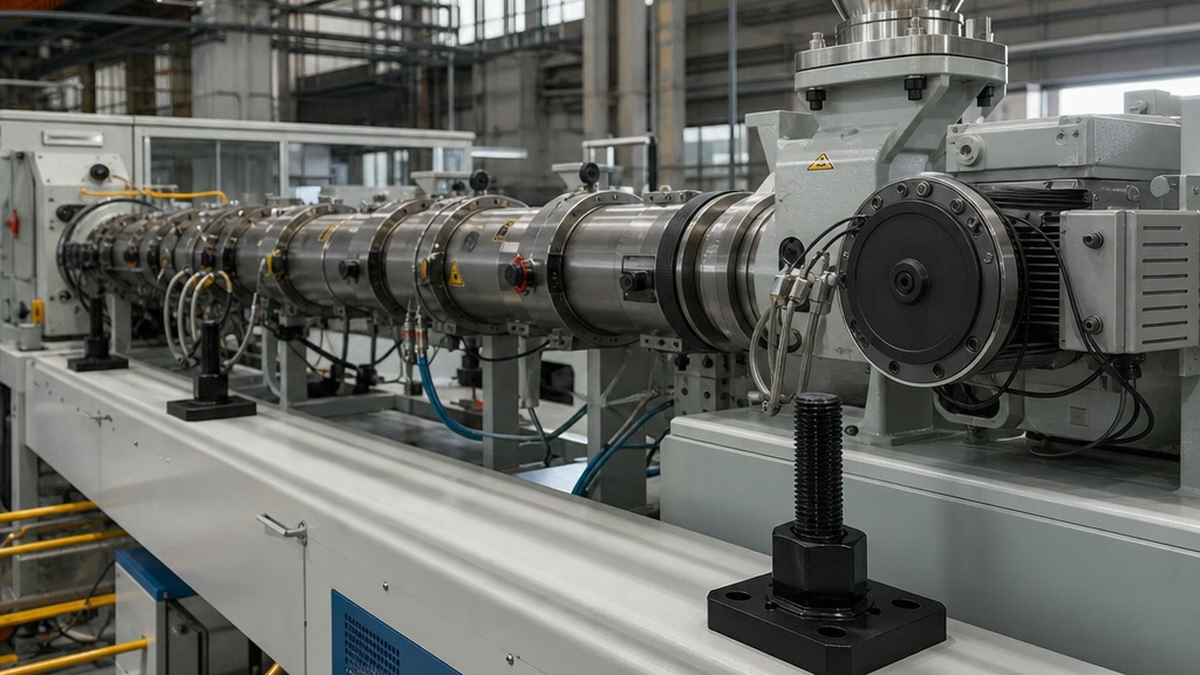
A plastic extruder melts resin pellets or powder through a heated barrel, pushed forward by a rotating screw, and forces the melt through a shaped die. That two-sentence summary hides the engineering decisions that directly set the price.
Screw design is the core variable. A single screw extruder uses one helical screw to convey, melt, and pressurize the plastic. It handles the widest range of commodity resins — HDPE, LDPE, PVC, PP — at lower cost. A twin screw extruder uses two intermeshing screws (parallel twin configuration) that actively mix, compound, and de-gas the melt.
Twin screw machines cost more because they do more: blending additives, processing moisture-sensitive resins, running glass-fiber compounds that would degrade in a single screw.
The L/D ratio (length-to-diameter of the screw) also affects price. A 30:1 L/D screw provides longer melt residence time for better mixing; a 24:1 is cheaper and faster to build. Specifying the wrong L/D for your resin is a procurement error that shows up in product quality — not in the purchase invoice.
Extruder Types and What Each Line Configuration Costs
Single Screw Extruder Lines
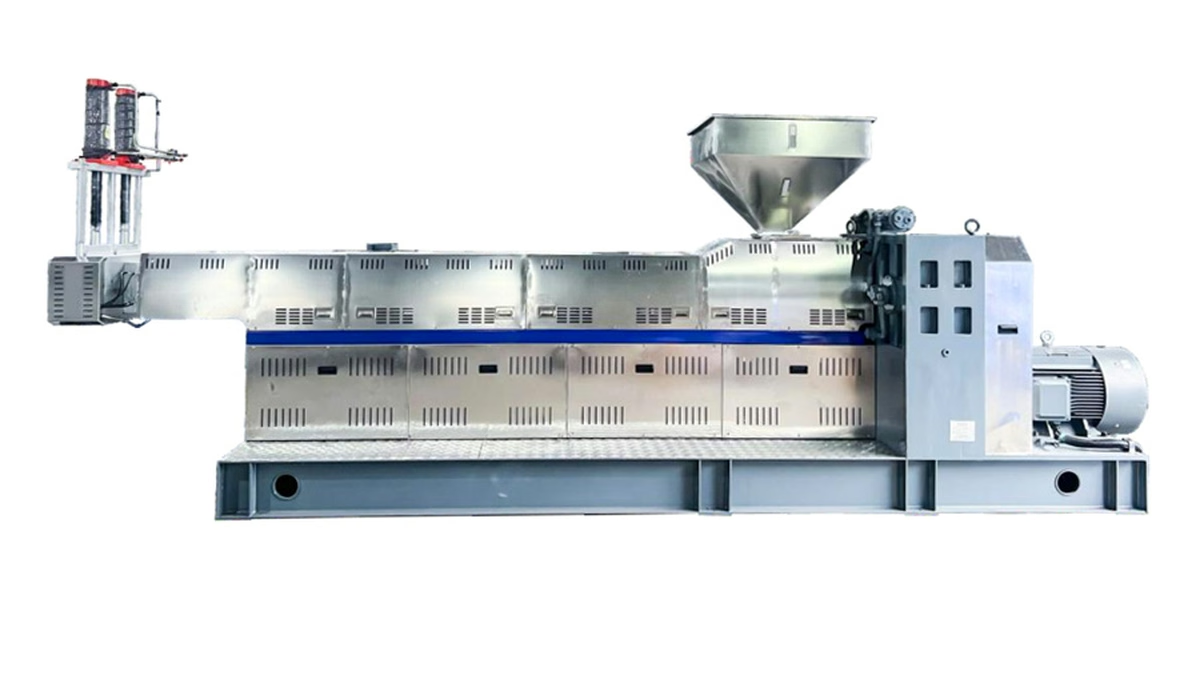
Single screw extruder lines remain the workhorse for pipe, profile, sheet, and packaging film production. For plastic extruder machine for sale in the U.S. market, a 65mm single screw extruder running HDPE or PVC profiles typically prices between $22,000 and $55,000 as a standalone unit. Add a downstream calibration and cutting system and that figure climbs to $50,000–$90,000.
For HDPE and LDPE blown film extrusion, a mono-layer blown film extruder with 500mm die and air ring runs $28,000–$65,000. Buyers processing HDPE/LDPE for agricultural or packaging applications should budget the full line, not just the extrusion machine price.
Twin Screw Extruder Lines
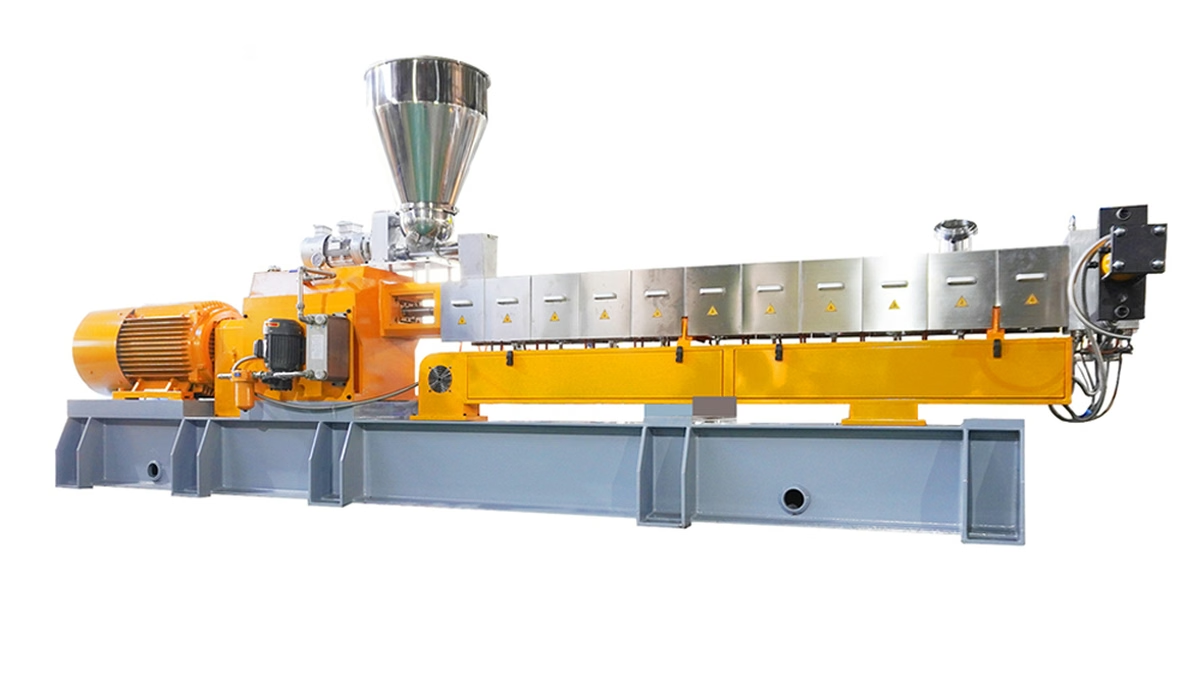
Twin screw compounding lines carry a premium for good reason. The parallel twin screw design generates intensive distributive and dispersive mixing that single screw machines cannot replicate. U.S. compounders running masterbatches, PVC compounds, or glass-filled engineering plastics routinely pay $80,000–$200,000 for a production-grade twin screw line, plus $15,000–$40,000 for downstream pelletizing.
The twin screw extruder price is also sensitive to torque spec. High-torque gearboxes — required for stiff compounds — add $12,000–$30,000 over standard configurations. That’s a number worth knowing before the quote arrives.
⚠️ Avertissement : Sourcing a twin screw extruder on machine price alone without specifying torque (Nm/cm³), L/D ratio, and screw material grade (38CrMoAlA nitrided vs. bimetallic) frequently results in a machine that underperforms on your actual compound — and rebuilding a screw set costs $8,000–$25,000.
| Machine Type | Typical U.S. Application | Price Range (FOB) | Key Spec to Verify |
|---|---|---|---|
| Single screw extruder (65mm) | PVC/HDPE pipe, profiles | $22,000–$55,000 | L/D ratio, screw material |
| Single screw blown film line | HDPE/LDPE packaging film | $28,000–$65,000 | Die diameter, output kg/hr |
| Parallel twin screw (75mm) | Compounding, masterbatch | $80,000–$160,000 | Torque, screw configuration |
| 3-layer co-extrusion blown film | Agricultural, stretch film | $90,000–$180,000 | Layer ratio control, film width |
| Pipe extrusion line 20–110mm | Water/gas supply pipe | $60,000–$130,000 | Vacuum tank length, haul-off speed |
| Pipe extrusion line 110–630mm | Infrastructure HDPE pipe | $150,000–$350,000 | Cooling capacity, cutter type |
Eight Product Lines That Tell You Where Real Price Variation Lives
These are the application-specific extrusion lines we configure most often for U.S. buyers — each one illustrates a different price driver.
HDPE/PE Artificial Grass and Turf Mat Extrusion
Artificial turf backing and PE plastic floor mat extrusion requires precision die design for multi-strand carpet grass filament and flat mat profiles simultaneously. The extrusion machine for this application combines a single screw extruder with a multi-hole spinneret die and tension-controlled winding. Machine prices for a plastic extrusion machine for sale configured for this output run $35,000–$75,000, with die tooling adding $8,000–$20,000 depending on strand count.
Tooling costs can be significant for first-time buyers in this product family; confirm the likely tooling budget with your supplier before finalizing your capital plan, as the proportion will vary by configuration.
HDPE/PP/PVC/PPR Pipe Extrusion Lines (20–630mm)
High-speed pipe extrusion production lines for water supply and gas supply pipe represent one of the widest price ranges in plastic machinery. A Factory Price HDPE Pipe Extrusion Line covering 20–63mm pipe runs $60,000–$130,000 as a complete production line. Scale to 315–630mm infrastructure-grade HDPE pipe and the line cost reaches $200,000–$350,000 — driven by the vacuum calibration tank length (10–12 meters), haul-off clamp force, and planetary cutter precision.
PPR and PVC lines in the same diameter bands are similarly priced, though the screw geometry differs to match each resin’s melt characteristics.
💡 Conseil de pro : For HDPE gas supply pipe, confirm the line meets ASTM D2513and that the extruder can maintain melt temperature stability within ±2°C — that tolerance is what regulatory qualification requires, not a nice-to-have.
PP/PET Strapping and Strap Band Extrusion Lines
PP strap and PET strapping band production lines combine a screw extruder with a flat die, stretching oven, and multi-roll orientation unit. The stretching station — not the extruder itself — is where quality and cost diverge. A complete PP strap extrusion line producing 12–19mm strapping belt runs $45,000–$90,000 FOB. PET strap lines handling heavier-duty industrial packing strip run $70,000–$120,000.
Output width and number of strands per die determine where in that range you land.
PVC/UPVC Window and Door Profile Extrusion
PVC window and door profile extrusion machinery requires a twin screw extruder (typically 65/132 or 80/156 parallel twin screw configuration) paired with precision multi-cavity profile dies, vacuum calibration tables, and optional lamination units.
This is one of the most technically demanding twin screw applications: UPVC is thermally sensitive, dies are expensive ($5,000–$25,000 per profile), and the production line must hold dimensional tolerances to ASTM C1396 levels. A complete PVC/UPVC profile frame extrusion line with two profile die sets runs $120,000–$220,000 in the U.S. market.
Adding an inline lamination and welding machine for finished-frame production adds $30,000–$60,000.
Stretch/Cast Film and Cling Film Co-Extrusion Lines
Double-layer or 2-layer LLDPE/PE stretch film and cling film cast co-extrusion lines sit in a price band that surprises many buyers: $80,000–$180,000 for a production-grade cast film line with 1,500–2,500mm web width, automatic tension control, and surface treater. The co-extrusion die head alone — a precision-machined feedblock distributing two or three layer ratios — accounts for $18,000–$40,000 of that total.
Preservative film and pallet wrap applications require this configuration; a single-layer blown film machine cannot produce the same optical clarity or cling performance that cast co-extrusion delivers.
3-Layer HDPE/LDPE/LLDPE Agricultural and Greenhouse Blown Film Lines
Three-layer agricultural blown film extrusion machines represent the intersection of output complexity and mechanical cost. A co-extrusion blown film line running HDPE outer layers with an LLDPE core for greenhouse or mulch film produces film properties no mono-layer line can match. Pricing for a production 3-layer blown film line with 1,000–2,000mm layflat width runs $90,000–$180,000 FOB.
Biodegradable film compounds (PLA/PBAT blends) require screw material upgrades and additional melt-temperature precision — add $12,000–$25,000 for that modification. The blown film extruder machine price for this tier reflects genuine engineering cost, not margin padding.
HDPE/LDPE Blown Film Monolayer Lines
For buyers who need polyethylene film production without co-extrusion complexity, monolayer HDPE/LDPE blown film extruder lines are the value entry point. A 55mm single screw blown film machine producing 500–800mm layflat runs $28,000–$50,000. Scaling to a 75mm extruder for heavier-gauge HDPE film pushes the line to $45,000–$75,000.
The hidden cost in this segment is the winder — a good automatic surface-winder adds $15,000–$30,000 and determines roll quality more than the extruder itself.
What Actually Moves the Extruder Machine Price
Beyond machine type, four variables routinely shift quotes by 20–50%:
Control system specification. A basic relay-logic panel versus a Siemens or Allen-Bradley PLC with HMI and remote diagnostics can add $8,000–$20,000 to any machine. For U.S. production environments requiring process data logging (FDA, food contact, traceability), that PLC is not optional.
Screw and barrel material grade. Standard 38CrMoAlA nitrided steel handles most commodity plastics. Bimetallic barrels and high-alloy screws for filled compounds (glass fiber, calcium carbonate, flame retardants) add $6,000–$18,000 per set, but they can meaningfully extend service life on abrasive materials — a total cost of ownership calculation, not a luxury.
Tooling and die sets. Dies are priced separately from the extruder in every credible quote. Profile dies range from $3,000 (simple tube) to $30,000+ (complex multi-cavity window frame). Buyers who compare extruder machine prices without comparing die costs routinely underbudget by 30–40%.
Downstream equipment scope. Calibrators, vacuum tanks, haul-off units, cutters, and winders are the “rest of the line” and they are frequently priced separately. A $45,000 pipe extruder with $55,000 of downstream becomes a $100,000 production line — but only the total figure reflects your actual capital outlay; comparing the machine-only number against a full-line quote from another supplier is an apples-to-oranges error.
Common Mistakes U.S. Buyers Make Comparing Extrusion Machinery
Comparing machine price without output spec. A 65mm single screw extruder at $22,000 and another at $38,000 may both be real quotes — but the first may be rated 80 kg/hr on HDPE while the second delivers 150 kg/hr. Output per dollar is the metric; price alone is noise.
Ignoring spare parts availability. Screw and barrel wear is predictable. A machine sourced purely on price from a supplier with no U.S. parts inventory can sit idle 6–12 weeks waiting for a replacement screw segment. Our customers who’ve experienced this once never repeat the error.
Overlooking voltage and electrical code compliance. U.S. installations require NEC-compliant control panels. Machines built to other electrical standards may require rewiring to meet applicable codes — a potentially significant additional cost that may not appear in the original machine price. Confirm the specific requirements and associated costs with your local authority having jurisdiction before finalizing your purchase.
Requesting price before specifying resin. Screw geometry is resin-specific. A screw optimized for HDPE will underperform on PVC. Suppliers who quote a generic plastic extruder machine price without asking for your resin family are not giving you a useful number.
How to Evaluate a Plastic Extruder Supplier Before Placing an Order
We’ve shipped machines to more than 40 countries across 300+ customer projects. The evaluation criteria that separate reliable suppliers from quote-only vendors are consistent:
- Factory audit or video walkthrough: request a live video of the actual machine running your target resin before shipment
- Test run report: temperature stability data, output rate verification, dimensional check on the extrudate
- Certification documentation: request applicable certification documents relevant to your market and installation requirements, and verify them with the issuing body; do not rely on a sticker alone
- Spare parts package: ask what a 2-year consumables kit costs and whether it ships with the machine
- Reference contacts: two customers running the same line configuration, in the same resin family, willing to take a call
A supplier who pushes back on any of those five points is telling you something useful.
📝 Remarque : For U.S. buyers, request that the control panel be built to UL 508A Industrial Control Panel standards— or budget separately for a local panel shop to rewire it. Either path is fine; the problem is assuming it’s covered when it’s not.
Making the Decision
The right plastic extruder machine price is the one that reflects your full line scope, your resin, your output target, and a supplier who will still be answering the phone when a screw segment needs replacing in year three.
If you’re at the evaluation stage, the most productive next step is a detailed line specification — resin family, output kg/hr, product dimensions, and control requirements — submitted for a formal itemized quote. That document transforms a price conversation into an engineering conversation, which is where the real value gets decided.
Vous avez un projet ou un cahier des charges ? Contactez mqextrusion.com : ce sont de vrais ingénieurs qui vous répondront.
FAQ
How much does a plastic extrusion machine cost?
A plastic extrusion machine in the United States typically costs between $20,000 and $750,000 depending on configuration. Entry-level single-screw units for simple profiles start around $8,000 to $18,000 FOB. Mid-range twin-screw compounding extruders run $40,000 to $200,000. High-output medical-grade or co-extrusion lines with downstream equipment can exceed $750,000. Screw geometry, barrel length-to-diameter ratio, control systems, and resin compatibility all shift the final number significantly beyond what throughput rating alone suggests.
What is the cost of extruder machine?
Extruder machine cost in the U.S. ranges from roughly $20,000 for a basic lab-scale or single-screw unit to over $500,000 for a fully integrated production line. The drive system, barrel metallurgy, venting configuration, and whether the machine handles commodity resins or engineering-grade materials like PEEK or fluoropolymers all add cost. Freight, installation, operator training, and spare-parts inventory typically add 10 to 20 percent on top of the quoted machine price.
How much does an extruder cost?
An extruder costs anywhere from $20,000 to $750,000 depending on configuration, with entry-level single-screw units for simple polyethylene or PVC profiles starting around $8,000–$18,000 FOB and production-grade twin-screw compounding systems reaching $80,000–$200,000 or more. U.S. buyers should also factor in die tooling, which adds $5,000 to $50,000 depending on profile complexity, plus downstream equipment like cooling tanks, haul-offs, and cutters. Buying used or refurbished equipment can cut upfront cost by 30 to 50 percent but may require retrofitting controls to meet current safety standards.
Is plastic extrusion expensive?
Plastic extrusion has high upfront capital costs but relatively low per-unit operating costs at volume, making it economical for continuous or high-run production. A complete U.S. production line can require $100,000 to $600,000 in initial investment. Energy, resin, and labor then drive ongoing costs. Compared to injection molding or 3D printing, extrusion delivers lower cost-per-pound for profiles, tubing, and sheet, so the process becomes cost-competitive quickly when annual volumes justify the capital commitment.
Sources
[1] D2513 Standard Specification for Polyethylene (PE) Gas … — store.astm.org
[2] medium-density polyethylene yellow gas — jmeagle.com
[3] D4726 Standard Specification for Rigid Poly(Vinyl Chloride … — store.astm.org
[4] Gypsum Board Thickness and Standard Sizes Guide — feeds.hammer-ims.com
[5] Blown Film Extrusion Machinery Market Size | CAGR of 4.7% — market.us
[6] NFPA 70 (NEC) Code Development — nfpa.org
[7] Industrial Control Panels and the Panel Shop Program — ul.com