Flame Retardant Polypropylene (PP) Production Process:Manufacturing Innovations
As global safety standards tighten across the automotive, electronics, and construction sectors, the demand for Flame Retardant Polypropylene (FRPP) has reached unprecedented levels. Valued at USD 3.8 billion in 2026 and projected to grow at a CAGR of 6.7% through 2032, FRPP is a critical material for modern manufacturing. But how exactly is this life-saving material produced, and what innovations are driving its evolution?
This comprehensive guide explores the state-of-the-art flame-retardant PP production process, market dynamics, and the industry’s massive shift toward halogen-free formulations.
What is Flame Retardant Polypropylene?
Polymer inherently burns easily. Polypropylene (PP), a highly versatile and cost-effective thermoplastic, has a Limiting Oxygen Index (LOI) of just 17-18% (meaning it easily catches fire in normal atmospheric conditions containing ~21% oxygen).
To meet stringent safety standards like UL94 V-0, PP must be compounded with flame-retardant (FR) additives. These additives work by interrupting the combustion cycle chemically in the gas phase, or physically in the condensed phase (e.g., by forming a protective char layer).
Market Data: The FRPP Landscape
| Metric | 2024 Value | Projection (2032) |
| Global FRPP Market Size | USD 3.8 Billion | USD 5.6 Billion |
| Annual Volume Demand | 1.85 Million Metric Tons | 2.65 Million Metric Tons |
| Halogen-Free (HFFR) Share | 62% | 85% |
| Primary End-Use Sector | E&E (Electrical & Electronics) – 38% | EVs & Automotive – 42% |
Data sourced from Grand View Research and PlasticsEurope.
The Step-by-Step Production Process
The production of flame-retardant PP is a highly precise compounding process. It involves integrating FR additives, synergists, and stabilizers into the base PP resin without degrading the polymer’s mechanical properties. Here is the modern industrial workflow:
1. Formulation and Precision Dosing
The process begins with the exact formulation. Depending on the desired flame-retardant mechanism, manufacturers use gravimetric loss-in-weight feeders to ensure dosing accuracy within ±0.1%.
- Base Resin: PP Homopolymer or Copolymer (typically 60-80% of the mix).
- FR Additives: Brominated compounds (declining), or Halogen-Free Flame Retardants (HFFR) such as intumescent systems, Ammonium Polyphosphate (APP), or Magnesium Hydroxide (MDH) (making up 20-40% of the mix).
- Synergists & Modifiers: Antioxidants, UV stabilizers, and impact modifiers.
2. Melt Compounding via Twin-Screw Extrusion
The core of the FRPP production process is the co-rotating twin-screw extruder. This machine provides the intense shear and mixing required to disperse the FR additives evenly into the polymer matrix.
- Temperature Profile: Extrusion temperatures are tightly controlled, usually between 190°C and 220°C. Crucial SEO Note: For halogen-free intumescent systems, temperatures must not exceed 230°C to prevent premature activation (foaming) of the flame retardant within the barrel.
- Screw Configuration: High-shear kneading blocks are strategically placed to ensure micro-dispersion of solid FR particles, which is vital for maintaining the material’s impact strength.
3. Degassing / Venting
During extrusion, moisture and volatile organic compounds (VOCs) are generated. Vacuum venting zones along the extruder barrel extract these gases. Proper degassing is critical to prevent porosity (bubbles) in the final product, which would compromise electrical insulation properties.
4. Cooling and Pelletizing
Once the compounded melt exits the extruder die head as continuous strands, it enters a water cooling bath.
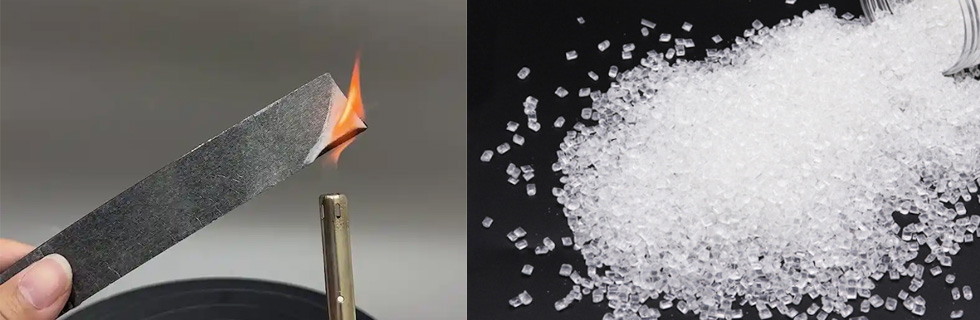
- Strand Pelletizing: The cooled strands are cut into uniform pellets (usually 2-3 mm in size).
- Underwater Pelletizing: For highly filled, brittle FR compounds, underwater pelletizing is increasingly preferred to minimize dust and ensure perfectly spherical pellets.
5. Quality Control and Testing
Before packaging, the batch undergoes rigorous QC testing:
- UL94 Flammability Test: Ensuring the material self-extinguishes within 10 seconds (V-0 rating) without flaming drips.
- Glow Wire Test (GWFI/GWIT): Crucial for European home appliance standards (IEC 60335-1).
- Mechanical Testing: Measuring tensile strength, elongation at break, and Izod impact strength.
The Big Shift: Halogenated vs. Halogen-Free (HFFR)
Historically, brominated flame retardants (combined with antimony trioxide) were the standard. They were highly effective at low loadings (10-15%). However, due to environmental toxicity, bioaccumulation risks, and the generation of corrosive smoke during a fire, the industry is heavily pivoting.
The Rise of Intumescent Systems (Halogen-Free)
Halogen-Free Flame Retardant Polypropylene (FRPP) represent 62% of the FRPP market. Intumescent systems (typically Phosphorus-Nitrogen based) are the leading technology.
- How it works: When exposed to fire, intumescent FRPP swells and forms a thick, porous carbon char layer. This char acts as an insulating barrier, cutting off oxygen and protecting the underlying polymer.
Advantage: Zero toxic halogen smoke, lower density than mineral-filled FRs, and compliance with the EU’s REACH and RoHS directives.
Key Applications Driving Production
- Electric Vehicle (EV) Battery Components: The EV boom is single-handedly reshaping FRPP production. Battery modules, high-voltage connectors, and thermal management systems require lightweight, chemically resistant FRPP with V-0 flammability ratings.
- Electrical & Electronics (E&E): Sockets, switches, server housings, and wire/cable insulation rely heavily on HFFR PP to meet strict consumer safety mandates.
- Home Appliances: Washing machine drums, TV back covers, and microwave components require Glow-Wire compliant Flame Retardant Polypropylene (FRPP).
Future Trends in FRPP Manufacturing
- Nanocomposites : The integration of Carbon Nanotubes (CNTs) and Graphene in fractional percentages (0.5-2%) is being used to act as synergists, improving char formation while simultaneously enhancing the mechanical stiffness of the PP compound.
- Circular Economy: Producing Flame Retardant PP using Post-Consumer Recycled (PCR) polypropylene. Innovative compatibilizers are now allowing manufacturers to produce V-0 rated PP using up to 30% recycled feedstock.
- Smart Manufacturing: Industry 4.0 integration in compounding plants is reducing scrap by monitoring melt viscosity and additive feed rates in real-time.
Conclusion
The Flame Retardant Polypropylene production process sits at the intersection of advanced chemistry and precision heavy machinery. As regulatory pressures phase out toxic halogens and the electrification of transport accelerates, the compounding industry is rapidly innovating.
MQ provides a complete set of technical solutions and twin-screw modification equipment, enabling technology and formulas to meet the standards you desire, for Flame Retardant Polypropylene PP.