Filler Masterbatch: 5 Proven Steps to Cut Plastic Production Costs by 15%
Filler masterbatch is a concentrated blend of mineral fillers — most commonly calcium carbonate (CaCO3) — dispersed in a polymer carrier and pelletized for direct feeding into extrusion or injection lines. Used correctly, it reduces material costs by 15–35%[1] per pound of finished plastic product while maintaining or improving dimensional stability, stiffness, and surface finish.
Step 1: Understand What Filler Masterbatch Actually Is
Why this matters: Half the failed implementations we see come from buyers treating this additive as a simple “cost filler” rather than an engineered material. Understanding its composition changes how you spec it, buy it, and process it.
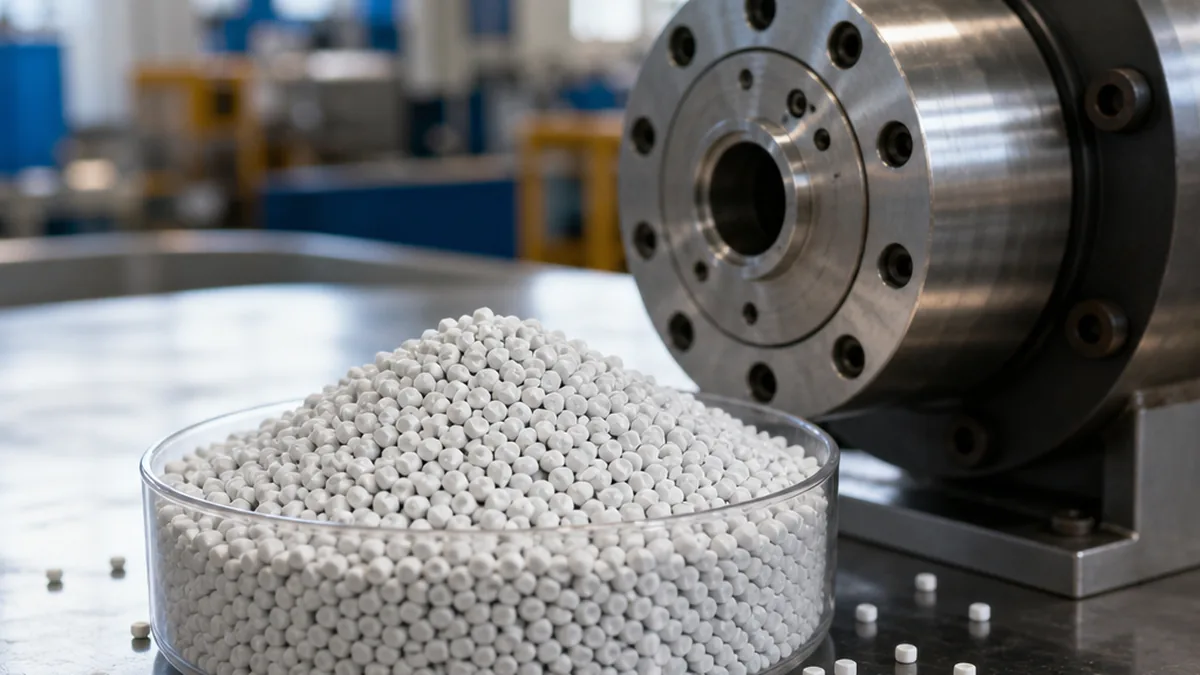
Filler masterbatch is not raw mineral powder. It is a pre-dispersed concentrate: inorganic filler particles — most often carbonate CaCO3, sometimes barium sulfate — surface-treated with stearic acid or coupling agents, then melt-compounded with a carrier polymer at 60–80% filler loading. That concentrate is then let down in your production line at 10–40% addition rates to produce the final plastic product.
The surface treatment step is what separates quality filler masterbatch from cheap powder-blended alternatives. Without it, hydrophilic mineral particles cluster in the polymer matrix, creating stress concentrations that reduce elongation and impact strength. Surface-treated calcium carbonate particles bond at the polymer interface — which is why this additive can actually improve stiffness in thin-wall injection-molded plastic products, not just reduce their cost.
The HS code for filler masterbatch[2] in the U.S. falls under HTS 3206 (other coloring matter; preparations) — relevant for procurement teams managing landed-cost calculations on imported concentrate.
What you’ll need before starting:
- Your base polymer (PP, PE, PVC, ABS, etc.) — carrier resin must match or be compatible
- Your product’s performance specs: tensile strength, elongation, impact resistance, dimensional tolerances
- Your current material costs per pound, so you can calculate actual savings after trials
- Lab-scale twin-screw extruder for initial compounding trials (or access to a toll compounder)
- Melt flow index (MFI) tester and tensile test specimens per ASTM D638[3]
- Your line’s processing parameter sheet: barrel temperatures, screw speed, throughput rate
📝 Note: In our experience working with over 300 customers across 40+ countries, the most common pre-trial mistake is sourcing masterbatch without confirming the carrier resin. A PP-based concentrate fed into a PE line causes compatibility issues that show up as streaks, delamination, or brittleness — problems that waste an entire production run before the root cause is identified.
Watch out for this: Buyers often conflate “filler” with “white masterbatch.” White masterbatch uses titanium dioxide (TiO2) as its primary pigment for opacity. Filler masterbatches use CaCO3 primarily for cost reduction and stiffness, with whitening as a secondary effect. Speccing white masterbatch when you need the filler variety adds 30–60% to additive cost for no structural benefit.
How Filler Masterbatch Is Manufactured
Understanding the manufacturing process matters for procurement because it explains why lot-to-lot consistency varies between suppliers — and why that variation hits your production costs directly.
Quality filler masterbatches are produced on twin-screw extruders or co-kneaders, not single-screw lines. The distinction is significant: twin-screw equipment delivers the distributive and dispersive mixing needed to break mineral agglomerates below 10 µm, while co-kneaders handle ultra-high filler loadings (above 75%) that would stall a twin-screw. Most U.S. and European masterbatch suppliers use co-rotating twin-screws for standard CaCO3 grades (60–75% loading) and switch to co-kneader configurations for specialty high-density products.
Surface-coating chemistry is selected based on the target polymer matrix. Stearic acid coating — the most common treatment — works well in polyolefin systems (PP, PE) because the acid’s fatty-chain structure is compatible with non-polar polymer chains. For engineering resins like ABS or nylon, silane coupling agents are preferred: they create covalent bonds at the mineral surface that survive the higher processing temperatures these resins require, where stearic acid would volatilize and leave uncoated particles.
Precipitated calcium carbonate (PCC), used in thin-film applications, requires additional process control: PCC particle size[4] runs 0.5–2 µm — roughly one-tenth the size of standard ground calcium carbonate (GCC) grades — and achieving that consistency demands tight reactor temperature and seed crystal management in the precipitation stage, not just milling.
The practical consequence for buyers: lot-to-lot filler loading consistency is a function of the manufacturer’s process control, not just their QC lab. A supplier running ±5% loading variation between lots is running a poorly controlled process. In our work across pipe extrusion lines in the U.S., we specify ±2% as the acceptance tolerance on incoming Certificate of Analysis data — anything wider than that drifts your blend ratio and your actual material costs without a visible warning flag until yield numbers come in at end of month.
Step 2: Choose the Right Filler Type for Your Application
Why this matters: The wrong filler type degrades product quality at the finished-goods level — often in the field, after the product has shipped.
The three types our engineering team encounters most frequently in plastic manufacturing:
- Calcium carbonate (CaCO3) filler masterbatch — the dominant product. Ground calcium carbonate (GCC) grades suit film, pipe, and injection-molded parts. Precipitated calcium carbonate (PCC) offers finer particle size (0.5–2 µm) for thin-film applications where surface defects matter.
- Barium sulfate filler masterbatch — higher density, excellent X-ray opacity, used in medical plastic products and automotive components requiring sound dampening. Material costs run 3–5× higher than CaCO3, so it is only justified where density or opacity is a performance requirement, not a cost play.
- Talc-filled masterbatch — used when stiffness-to-weight ratio matters more than cost reduction alone, common in automotive components and appliance housings where dimensional stability under heat is specified.

⚠️ Warning: Loading rates above 40% in PE film applications cause pinholes and reduced elongation at break. On most first orders from film converters, we see the same pattern: the buyer requests the highest-loading product available to maximize cost savings, then finds the finished film fails the dart-drop test. Start at 20% addition rate and step up in 5-point increments with mechanical testing between each trial.
Watch out for this: Selecting based on filler percentage alone without checking particle size distribution (PSD). A D97 of 15 µm is acceptable for thick-wall pipe; it causes surface defects on cast film or nonwoven applications where D97 must be below 5 µm.
Step 3: Calculate Your Actual Cost Savings Before Committing to Volume
Why this matters: This additive always reduces raw material costs per pound — but the net impact on production costs depends on your addition rate, product price, and any processing adjustments required.
⚠️ Density caveat for film buyers: CaCO3-filled compounds are 5–15% denser than unfilled polymer. If you sell film by area (square feet or linear yards), the density increase means fewer square feet per pound of compound — partially offsetting the savings shown in the table below. Adjust your model on a per-square-foot basis before drawing conclusions from the weight-based figures.
A straightforward cost model used across plastic manufacturing operations:
Net material cost per lb of compound =
(Virgin polymer % × polymer $/lb) + (Filler masterbatch % × masterbatch $/lb)
Example with U.S. market prices[5] as of mid-2025:
– Virgin PP homopolymer: $0.72/lb
– CaCO3 filler masterbatch (80% CaCO3, PP carrier): $0.45/lb
– At 25% addition rate: blended cost = (0.75 × $0.72) + (0.25 × $0.45) = $0.65/lb — a 9.7% reduction in material costs
At scale — 500,000 lb/year of PP production — that differential saves approximately $35,000 annually in material costs alone. Customers running continuous pipe extrusion lines see the fastest payback because this additive also improves melt back-pressure stability, which lifts production efficiency and reduces scrap rates simultaneously.
| Item | Value |
|---|---|
| 0% | 1.59 |
| 10% | 1.53 |
| 20% | 1.47 |
| 30% | 1.41 |
| 40% | 1.35 |
| Loading Rate | Blended Cost ($/lb) | Cost Savings vs. Virgin PP |
|---|---|---|
| 0% (virgin PP only) | $0.720 | — |
| 10% filler masterbatch | $0.621 | 3.8% |
| 20% filler masterbatch | $0.603 | 7.5% |
| 30% filler masterbatch | $0.585 | 11.3% |
| 40% filler masterbatch | $0.567 | 15.1% |
Prices based on U.S. spot market mid-2025; actual savings depend on negotiated masterbatch pricing and freight. Film buyers: apply the density correction above before using these figures.
Step 4: Configure Your Extrusion Line for Filler Masterbatch
Why this matters: This concentrate changes melt rheology. Running it through an unmodified processing profile produces voids, shark-skin, or surging — all of which hurt product quality and waste material.
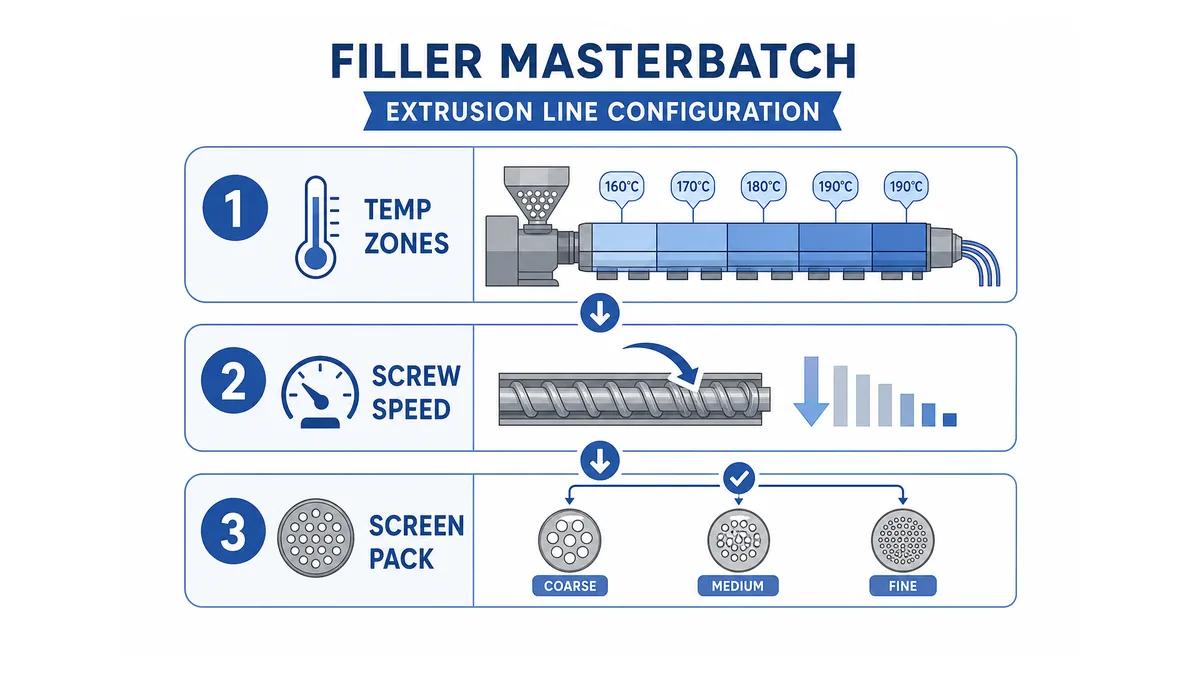
Key adjustments for extrusion lines:
- Temperature profile: CaCO3 concentrate increases thermal conductivity of the melt. Reduce barrel zone temperatures by 5–10°C from your virgin-resin baseline to avoid premature degradation of the carrier polymer.
- Screw speed: Higher filler content increases melt viscosity slightly. Most operators find a 5–8% reduction in screw RPM maintains consistent output without excessive shear heating.
- Screen pack: Use a finer screen (150–200 mesh) than you would for unfilled resin. Mineral filler aggregates will blind a coarse screen faster and require more frequent changes.
- Back pressure: The additive improves back-pressure stability, which benefits dimensional stability in pipe and profile applications.
💡 Pro tip: Our engineers recommend running a 2-hour stabilization period after any addition rate change before pulling QC samples. The compound affects residence time distribution in the barrel, and the first 30–45 minutes after a rate change often shows higher variability in melt temperature and output rate than steady-state conditions.
In our experience, operators who skip the screen pack upgrade end up attributing the resulting die pressure spikes to the masterbatch itself rather than to blocked screens — and they pull back on loading rate when the real fix costs about $40 and 20 minutes of downtime.
Step 5: Validate Product Quality Before Full Production
Why this matters: Filler masterbatch improves certain properties (stiffness, dimensional stability, surface hardness) while reducing others (elongation, impact resistance). A validation protocol catches failures before they reach customers.
Minimum test battery for U.S. plastic products:
- Tensile strength and elongation at break — ASTM D638[3]. Expect elongation to decrease 20–40% at 30%+ loading. Set your acceptance floor before trials.
- Melt flow index — ASTM D1238[6]. This additive typically raises MFI by 10–20% at moderate loading rates; confirm your downstream forming process (blow molding, thermoforming) can handle the change.
- Flexural modulus — ASTM D790. This usually improves with CaCO3-based masterbatch — confirm it meets your product spec.
- Visual inspection — 100 lux minimum, check for streaks, gels, pinholes, and surface roughness against your approved sample.
📝 Note: Customers in the agricultural film segment — where thin-wall plastic products must survive UV exposure and mechanical stress outdoors — consistently find that the validation step surfaces formulation issues that would have generated warranty claims. The validation protocol works precisely because it exposes the elongation trade-off before full production volume commits to a formulation.
Watch out for this: Validating at lab scale and skipping a full production-rate trial. Shear rates at production throughput are 3–10× higher than lab extruder rates, which changes filler dispersion and can cause issues not visible in lab specimens.
Current Trends in the Filler Masterbatch Market
The filler masterbatch market is shifting in ways that affect both what U.S. buyers can source and what their customers increasingly require them to prove.
Reshoring is changing U.S. demand patterns. Post-2024 tariff adjustments on imported polymer compounds pushed several mid-size U.S. packaging converters to bring compounding in-house rather than buy pre-compounded resin. That shift increases direct demand for filler masterbatches as a discrete additive rather than as an embedded component in a purchased compound — and it puts more U.S. operators in the position of running their own addition-rate optimization for the first time.
Bio-based carrier resins are moving from R&D to commercial trials. At least three major European masterbatch producers exhibited PLA-carrier and bio-PP-carrier filler masterbatches at K 2025, targeting compostable packaging lines. U.S. adoption is early — most domestic film converters report that bio-carrier grades run 20–30% more expensive than standard PP-carrier products and have narrower processing windows — but the segment is growing as brand owners with 2030 sustainability commitments look for ways to maintain CaCO3 cost benefits inside recyclable or compostable structures.
FDA indirect-food-contact compliance is tightening. Historically, FDA 21 CFR Part 178[7] governed acceptable additives in food-contact plastics, and most standard stearic-acid-coated CaCO3 grades qualified. As of 2025, several large U.S. food packaging buyers have begun requiring suppliers to document the specific surface-treatment chemistry — not just that the product is “food-contact compliant.” That distinction matters because some silane coupling agents used on specialty PCC grades are not listed under Part 178. U.S. buyers sourcing filler masterbatch for any food-contact application should confirm the surface-treatment chemistry with their supplier and run it through their compliance team before committing to volume.
Dust elimination is now a facility-compliance argument, not just convenience. Raw mineral filler generates combustible dust classified under OSHA 29 CFR 1910.272[8]. Switching to pre-pelletized filler masterbatch eliminates that classification entirely, which matters for U.S. facilities facing OSHA compliance reviews — a point procurement teams are increasingly using to justify the masterbatch price premium over raw powder to their finance departments.
Troubleshooting Common Filler Masterbatch Problems
| Problem | Likely Cause | Fix |
|---|---|---|
| Streaks or marbling on surface | Poor dispersion — carrier resin incompatibility or low melt temperature | Confirm masterbatch carrier matches base polymer; raise barrel zone 2–3 temperatures by 5°C |
| Product brittleness / low impact | Addition rate too high or incorrect filler particle size | Reduce loading 5 percentage points; request PSD datasheet from supplier — D97 should be ≤10 µm for most applications |
| Increased die pressure / surging | Screen pack blocked by filler aggregates or addition rate too high | Replace screen pack; reduce addition rate; check masterbatch quality with sieve test |
| Density increase causing yield loss | CaCO3 content raised specific gravity above spec | Recalculate cost model on area/volume basis (sq ft or linear yards) rather than weight; adjust line speed to compensate |
What to Do Next
Working out the correct filler masterbatch formulation for your line is a 2–4 week process when done systematically — from resin compatibility confirmation through full production-rate validation. The biggest variable is getting the first sample specification right so you’re not cycling through mismatched carrier resins or wrong particle sizes.
Our engineers at MQ Extrusion bring up to 28 years of plastic machinery experience to this process, and across more than 300 installations — pipe extrusion lines, film converters, injection molding operations — the pattern is consistent: the operations that hit their cost targets reliably are the ones that validated addition rate, particle size, and carrier compatibility before committing to volume, not after. The filler masterbatch extrusion equipment guide covers the machine-side specifications in detail. If your line is currently running virgin polymer only, the twin-screw extruder configuration for masterbatch explains screw geometry choices that make higher addition rates more forgiving.
For U.S. buyers sourcing concentrate, confirm your supplier provides a Certificate of Analysis with each lot — including MFI, moisture content, and filler loading percentage. Lot-to-lot variation above ±2% loading is a production-cost problem in disguise: your blend ratio and your actual material costs drift without a visible warning until yield numbers land at end of month. That discipline, combined with the five steps above, is what separates plastic manufacturers who consistently hit their cost targets from those who see unexplained yield variation quarter after quarter.
Quick AI summary
Quick answer
Filler masterbatch — a pre-dispersed concentrate of surface-treated calcium carbonate pelletized in a polymer carrier — is added at 10–40% let-down ratios on extrusion or injection lines. Used correctly in U.S. plastic manufacturing, it reduces material costs by 15–35% per pound of finished product while maintaining or improving stiffness and dimensional stability.
Key numbers
- Filler masterbatch reduces material costs by 15–35% per pound of finished plastic product when used correctly.
- Standard filler masterbatch is produced at 60–80% filler loading before let-down into the production line.
- Precipitated calcium carbonate (PCC) used in thin-film applications runs 0.5–2 µm in particle size — roughly one-tenth the size of standard ground calcium carbonate grades.
- Speccing white masterbatch (TiO2-based) instead of CaCO3 filler masterbatch adds 30–60% to additive cost with no structural benefit.
- Lot-to-lot filler loading variation wider than ±2% drifts blend ratios and actual material costs; ±5% variation signals a poorly controlled supplier process.
Do this, not that
- Confirm carrier resin compatibility before ordering — not after — a PP-based concentrate fed into a PE line causes streaks, delamination, or brittleness that can waste an entire production run before the root cause is found.
- Specify surface-treated CaCO3 — not raw mineral powder — untreated hydrophilic particles cluster in the polymer matrix, creating stress concentrations that reduce elongation and impact strength.
- Require ±2% loading tolerance on the supplier’s Certificate of Analysis — not ±5% — wider variation silently shifts your actual blend ratio and erases calculated cost savings.
- Use stearic acid coating for PP and PE lines — not for ABS or nylon — at the higher processing temperatures engineering resins require, stearic acid volatilizes and leaves uncoated particles; silane coupling agents are the correct choice for those systems.
FAQ
What is filler in plastics?
A filler in plastics is a mineral or inorganic material added to a polymer to reduce resin consumption and lower cost without compromising essential performance. Calcium carbonate, talc, and barium sulfate are common choices. Fillers increase bulk and can improve stiffness, dimensional stability, or surface finish depending on the grade selected. In U.S. manufacturing, calcium carbonate-based fillers are the most widely used because of their low price per pound and broad compatibility with polyolefin resins.
What Is Filler Masterbatch ?
Filler masterbatch is a pre-compounded pellet that carries a high loading of mineral filler, typically calcium carbonate, dispersed evenly in a polymer carrier resin. Manufacturers feed it directly into extruders or injection molding machines alongside virgin resin to replace a portion of the more expensive base polymer. The pellet form ensures consistent dispersion, reduces dust, and simplifies dosing. U.S. processors commonly use loadings of 20 to 80 percent CaCO3 to achieve material cost savings of 15 to 35 percent per part.
What are filler masterbatch’s applications in the plastic industry?
Filler masterbatch is used across blown film, cast film, injection molding, pipe extrusion, and thermoforming lines. Common U.S. applications include shopping bags, agricultural film, HDPE pipes, disposable cups, and rigid packaging. It also appears in construction products such as geomembranes and corrugated sheets. The right application depends on matching the carrier resin of the masterbatch to the base polymer in use, ensuring good compatibility and mechanical performance at the target filler loading.
Sources
[1] Calcium Carbonate Masterbatch: The Complete Buyer’s … — syntexamerica.com
[2] Filler Masterbatch HS Code 2025 — charmingmb.com
[3] D638 Standard Test Method for Tensile Properties of Plastics — store.astm.org
[4] Calcium Carbonate Applications in Industry – Apex-VN — vnapex.com
[5] Polypropylene – Price – Chart – Historical Data – News — tradingeconomics.com
[6] D1238 Standard Test Method for Melt Flow Rates of … — astm.org
[7] 21 CFR Part 178 — Indirect Food Additives: Adjuvants, … — ecfr.gov
[8] 1910.272 – Grain Handling Facilities — osha.gov