Plastic Extrusion vs Injection Molding: How to Choose the Right Process for Your Part
At a glance
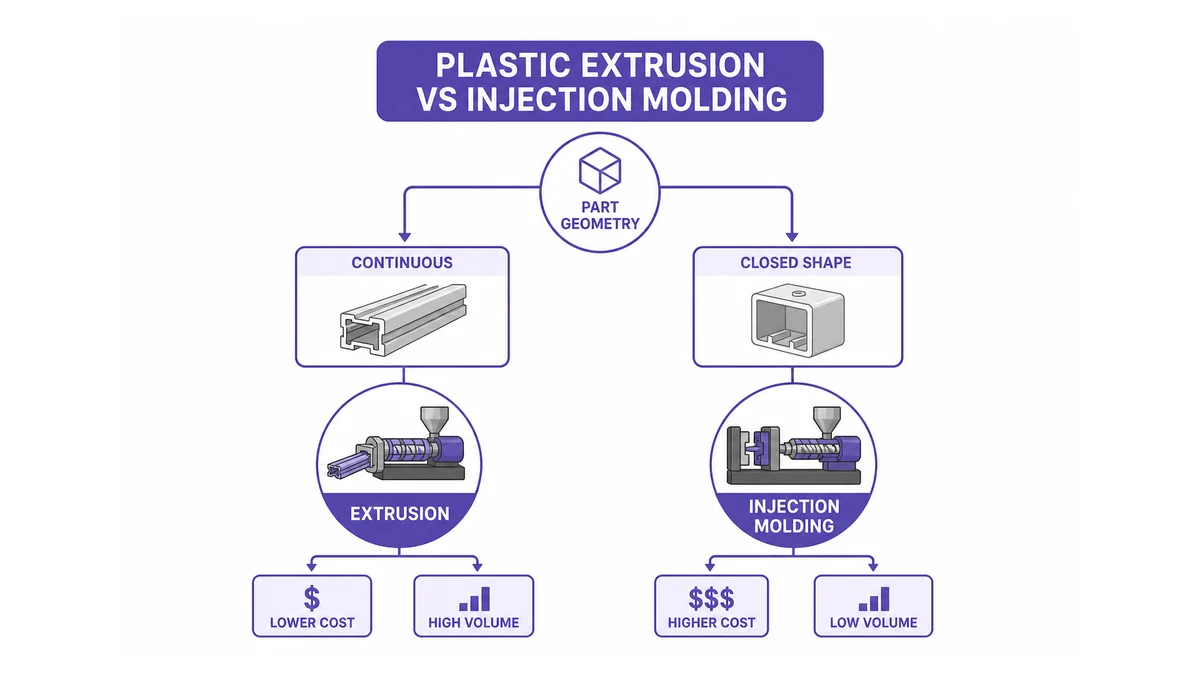
- Best for extrusion: Constant cross-section profiles — window frames, pipes, wire insulation, weatherstripping, tubing — produced in continuous lengths at high volume.
- Best for injection molding: Closed, three-dimensional parts with intricate geometry — housings, brackets, medical devices, consumer products — produced as discrete shots.
- Tooling costs: Extrusion dies typically run $1,000–$25,000; injection molds run $5,000–$100,000+ depending on part complexity and cavity count. [1]
- Cycle time: Extrusion runs continuously; injection molding cycles in 15–120 seconds per shot for most commercial parts.[5]
- Tolerances: Injection molding holds tight tolerances (±0.001–0.005 in.[6] typical); extrusion tolerances are looser, especially across the cross-section width.
- Volume break-even: Injection molding’s higher tooling costs require higher volumes to amortize — generally 10,000+ parts before per-unit cost undercuts alternatives.
- Material flexibility: Both processes handle commodity and engineering-grade thermoplastics; extrusion also runs thermosets in specific configurations, while injection molding dominates for glass-filled, high-performance compounds.
How we compared these two processes
Every dimension below was evaluated on the same six criteria: part geometry capability, tooling costs, per-unit production cost at scale, dimensional tolerances, material compatibility, and lead time to first production parts. We draw on over 15 years of extrusion machinery development — including work with customers across more than 40 countries on laboratory-scale through high-volume production lines — to give you specifics, not generalities.
The comparison is honest in both directions. Extrusion is our core business, and we’ll tell you when injection molding is the right call.
What is extrusion molding — and where it actually fits
The extrusion process forces molten plastic through a shaped die opening, producing a continuous profile that is then cooled and cut to length. The die geometry determines the cross-section; everything extruded shares the same cross-section from end to end.
That constraint is also the process’s greatest strength. Because the die is a relatively simple steel opening rather than a closed cavity, tooling costs stay low and lead times are short. A custom pipe or window-seal profile can go from concept to running production in two to six weeks, compared to eight to sixteen weeks for a complex injection mold.
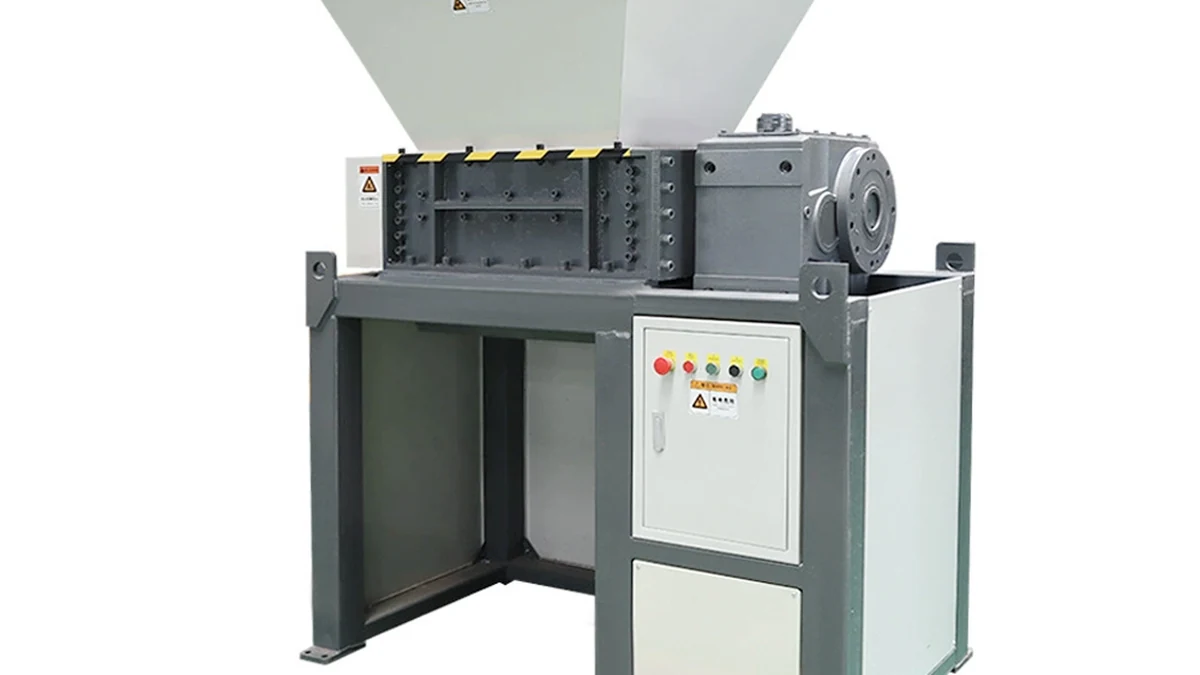
Where extrusion excels:
- Pipe, tubing, and conduit in any thermoplastic (PVC, HDPE, PP, nylon)
- Window and door profiles, including co-extruded multi-layer constructions
- Wire and cable jacketing, where continuous coverage over a conductor is required
- Sheet and film — both roll-to-roll and cut-to-length formats
- Custom weatherstripping, gaskets, and seals with constant cross-sections
The extrusion process is genuinely poor at anything that changes shape along its length. A part with a boss, a snap-fit latch, or a through-hole perpendicular to the profile axis cannot be extruded — full stop. Attempting secondary operations (drilling, milling) to add features post-extrusion adds labor cost and often undermines the economics that made extrusion attractive in the first place.
⚠️ Warning: Specifying extrusion for a part that requires cross-sectional variation at any point along its length is the most common geometry mismatch we see on first-project briefs. Review the full 3D model before committing to a process.
Disadvantages of extrusion:
- Tolerances across the profile width are harder to hold than injection molding — thermal variation during cooling affects dimensions, particularly on wide, thin-wall profiles. Typical extrusion tolerances are approximately ±0.005–0.015 in. on profile width and wall thickness, depending on material, profile complexity, and calibration tooling setup; confirm achievable tolerances with your processor for the specific profile geometry.
- Intricate interior geometry (undercuts, blind pockets, side features) is impossible without post-processing.
- Scrap from startup purging and length-end trim is unavoidable, though recoverable.
- Surface finish on the die-contact face is generally good, but the opposite (cooled) face depends heavily on calibration tooling setup.
Injection molding: strengths and real limitations
Injection molding injects molten plastic under high pressure into a closed mold cavity, holds it while it solidifies, then ejects the finished part. The mold defines every surface of the part — which is why injection molding produces complex parts with tight tolerances, living hinges, overmolded inserts, and fine surface texture in a single shot.
That capability carries a price. Mold cavity fabrication for a mid-complexity part in P20 steel typically runs $15,000–$50,000 before the first part is made. Aluminum prototype molds lower this to $3,000–$12,000 but sacrifice longevity and precision. The plastic injection molding cost structure is front-heavy: tooling is expensive, but per-unit costs drop steeply once the mold is paid for.
At 50,000+ parts, injection molding is almost always the lowest per-unit cost process for three-dimensional parts.
Where injection molding excels:
- High-volume production of complex, three-dimensional parts
- Parts requiring tight tolerances across multiple dimensions simultaneously
- Multi-material or multi-shot parts via overmolding vs injection molding techniques
- High surface quality requirements — Class A finish, textured surfaces, optical clarity
Genuine limitations:
- Tooling lead time is the longest of any plastic process — 8 to 20 weeks for a production-grade steel mold.
- Design changes post-tool are expensive; adding material to a cavity is difficult, removing it (steel-safe design) is the required philosophy.
- Thin-wall, very long parts with consistent cross-section are inefficient — the process produces a discrete part, not a continuous run, so throughput per press-hour is lower than extrusion for profile-type geometries.
- Residual stress from high injection pressures can cause warpage in large, flat parts — a problem that vacuum forming vs injection molding comparisons often surface when flat panels are involved.
Side-by-side: cost and tooling
This is where the decision often gets made — and where the most confusion lives.
Lower tooling costs for extrusion are real but require context. An extrusion die for a simple solid profile might cost $1,500–$5,000. A complex hollow profile with multiple chambers (like a window frame) can reach $20,000–$30,000. Still lower than a comparable injection mold, but not trivially cheap.
Injection mold tooling costs scale sharply with complexity. A single-cavity mold for a simple enclosure: $8,000–$20,000. A four-cavity family mold with side actions for a consumer product: $40,000–$80,000. [2] The upside is that a well-maintained steel mold runs 500,000 to 1,000,000+ shots before it needs major rework.
Per-unit economics flip at different volume thresholds:
| Volume | Extrusion (est. $/unit) | Injection Molding (est. $/unit) |
|---|---|---|
| 1,000 | ~$0.80 | ~$8.50 |
| 10,000 | ~$0.30 | ~$1.20 |
| 100,000 | ~$0.12 | ~$0.18 |
| 500,000 | ~$0.08 | ~$0.06 |
Estimates assume comparable material weight and commodity resin. Actual costs depend on wall thickness, resin grade, machine size, and geography.
The crossover point for comparable geometry is typically in the 50,000–150,000 unit range. Below that, extrusion’s lower tooling gives it a per-unit cost advantage for profile-type parts. Above it, injection molding’s faster cycle times and higher cavitation win on per-unit cost.
Side-by-side: geometry, tolerances, and part complexity
Injection molding holds tighter tolerances because the mold cavity constrains the part on all surfaces simultaneously during cooling. Achievable tolerances vary with part geometry, material, and mold quality; as a general guide, commercial-grade parts typically hold tighter tolerances across critical dimensions than extrusion, while precision molds for medical or optical applications can achieve significantly tighter results — confirm specific tolerance targets with your molder and the applicable industry standard for your application. [3]
Extrusion tolerances are adequate for most profile applications — pipe OD to ASTM standards, for instance — but the process cannot match injection molding’s precision on complex, multi-axis geometries. Typical extrusion tolerances are approximately ±0.005–0.015 in. on profile dimensions, depending on material, profile complexity, and calibration tooling; thermal gradients across a wide profile during cooling introduce variation that calibration tooling reduces but does not eliminate.
Part complexity tells the clearest story. Injection molding produces intricate, three-dimensional shapes — threaded bosses, snap-fit arms, undercut features, thin-wall ribbing — in a single operation. Extrusion produces uniform cross-section profiles only. A part that looks like it could be extruded but has a single perpendicular hole requires a secondary operation; a part with multiple perpendicular features should be injection molded from the start.
Processes like compression vs injection molding, transfer molding vs injection molding, or rotomolding vs injection molding sometimes compete for specific applications (large hollow parts, thermoset materials, low-volume runs). For the mainstream commercial plastic parts market, the extrusion vs injection molding choice covers the majority of design decisions — though the precise share varies by industry segment; verify what applies to your specific market with industry associations or your process engineer.
Is extrusion cheaper than injection molding?
For profile-type parts at any volume, yes — extrusion carries lower tooling costs and comparable or lower per-unit costs throughout the production life. For discrete three-dimensional parts, no — once volume exceeds the tooling amortization threshold, injection molding’s per-unit economics are superior, and extrusion simply cannot produce those geometries at all.
The honest answer: cost comparison is only meaningful after geometry locks the process. If your part can be extruded, it should be — the economics favor it. If it cannot, injection molding’s higher tooling cost is not optional; it is the entry price for that part geometry.
💡 Pro tip: Before requesting quotes for either process, freeze your cross-section drawing (for extrusion) or fully gated 3D model (for injection molding). Quoting from sketches produces estimates that diverge by 3× or more from actual tooling costs.
What are the four types of plastic molding?
The four processes most commonly grouped under “plastic molding” are:
- Injection molding — high-pressure injection into a closed mold cavity; highest tooling cost, highest precision, best for complex parts at volume.
- Blow molding — extrudes or injects a parison (hollow tube), then inflates it against a mold; used for bottles and hollow containers. Blow vs injection molding comparisons arise specifically for hollow part design.
- Compression molding — places a charge of material in an open mold, then closes it under pressure; common for thermosets and large structural composites. Compression vs injection molding decisions arise in aerospace and automotive.
- Rotational molding (rotomolding) — tumbles powdered resin in a heated mold; best for large, hollow, low-complexity parts at low volumes. Rotomolding vs injection molding is the relevant comparison for tanks, kayaks, and playground equipment.
Extrusion is a separate process family — it does not produce a closed, discrete part — but it is often listed alongside these four because it accounts for a large share of total plastic production volume in North America.
Thermoforming as a third path
Thermoforming vs injection molding is worth a brief note because it frequently enters the decision for large, flat or gently contoured parts — packaging trays, vehicle interior panels, equipment enclosures. Thermoforming heats sheet (often itself an extruded product) and draws it over a mold. Tooling costs are lower than injection molding, and part size can be much larger.
The trade-off: wall thickness uniformity is harder to control, and trimming adds secondary cost. Thermoforming vs injection molding cost comparisons typically show thermoforming winning for parts over 18 inches in any dimension at volumes below 50,000 units per year.
Decision matrix
| If your situation is… | Choose… |
|---|---|
| Part has constant cross-section, any length | Extrusion |
| Part is closed, three-dimensional, complex geometry | Injection molding |
| Volume is under 5,000 units, 3D part | Consider CNC vs injection molding or SLS vs injection molding for prototyping; revisit injection tooling at scale |
| Volume is 50,000+ units, 3D part | Injection molding — tooling amortizes quickly |
| Large, flat or gently curved panels, moderate volume | Thermoforming |
| Large, hollow, low-volume part (tanks, housings) | Rotomolding or blow molding |
| Overmolded assembly with rubber/TPE over rigid substrate | Injection molding (overmolding vs injection molding is actually a sub-type, not an alternative) |
| Thermoset material, large cross-section | Compression or transfer molding |
The process-geometry rule: a deeper look
The single insight missing from most extrusion vs injection molding comparisons is this: the geometry question is binary, not a preference.
Extrusion cannot produce a part that changes shape along its length. Injection molding cannot economically produce a part that requires a continuous, uniform profile over many feet. These are not trade-offs where you choose the cheaper option — they are hard constraints that eliminate one process before cost enters the picture.
A mistake we see on most first-project briefs is treating process selection as a cost optimization when it is actually a feasibility filter. Run the geometry check first: does the part maintain the same cross-section from end to end? If yes, extrusion is the candidate process. If no, injection molding (or one of the thermoset alternatives) is the path.
Once feasibility is established, then cost, tolerance requirements, and volume thresholds determine whether the lead process is genuinely optimal or whether a hybrid approach — extruded substrate with injection-molded end caps, for instance — reduces total part cost. Our engineering team has worked through this hybrid analysis on dozens of projects where the initial quote for a “pure” injection-molded part was 40–60% higher than a co-designed extrusion-plus-insert approach.
Pricing comparison
The following U.S. market ranges are indicative estimates for first-article tooling and per-unit production; actual costs vary with part complexity, material, machine size, supplier location, and market conditions. Confirm current pricing directly with your toolmaker or processor.
| Cost Item | Extrusion | Injection Molding |
|---|---|---|
| Simple die / single-cavity mold | $1,500–$8,000 | $5,000–$20,000 |
| Complex die / multi-cavity mold | $15,000–$35,000 | $30,000–$100,000+ |
| Per-unit cost at 10k units | $0.20–$1.50 (profile, by weight) | $0.80–$5.00 (part complexity dependent) |
| Per-unit cost at 100k units | $0.08–$0.50 | $0.10–$0.80 |
| Lead time to first parts | 2–6 weeks | 8–20 weeks |
Hidden costs to watch: extrusion lines require calibration tooling (haul-off, cooling tank, cutting unit) beyond the die itself — budget an additional 30–50% of die cost for the downstream tooling suite. Injection molding’s hidden cost is typically in secondary operations: degating, painting, assembly, and packaging that the mold quote never includes.
Which process fits your next part?
If your part is a continuous profile — pipe, seal, sheet, wire jacket — extrusion is the process, and the economics will confirm it. If your part is a three-dimensional object with features on multiple faces, injection molding is the process regardless of the tooling cost, because extrusion physically cannot produce it.
The interesting cases are hybrids and borderline geometries. If you are working through one of those — or if an initial injection mold quote has come back higher than your program can support — the geometry and process analysis is worth doing before you commit to tooling.
contact MQ extrusion engineering team Our team works through exactly these feasibility questions with new customers, and the answer is not always the process the initial design assumed.
Have a project or a spec sheet in hand? Talk to mqextrusion.com — real engineers answer.
FAQ
Is extrusion cheaper than injection molding?
Extrusion tooling typically costs far less than injection molds, often $1,000–$10,000 versus $8,000–$80,000 or more for injection molds in the United States (for example, a single-cavity mold for a simple enclosure runs $8,000–$20,000, while a four-cavity family mold with side actions for a consumer product can reach $40,000–$80,000). That makes extrusion cheaper to start. However, extrusion only works for parts with a constant cross-section. If your part needs complex 3D geometry, injection molding is the only viable option regardless of cost, so comparing prices only makes sense after confirming which process can actually produce your part.
What are the disadvantages of extrusion molding?
Extrusion is limited to parts with a uniform cross-section along their entire length, so enclosed features, bosses, or varying wall thickness are impossible without secondary operations. Dimensional tolerances are harder to hold than in injection molding because the hot profile can sag or warp before it fully cools. Joining or cutting extruded lengths into finished parts adds labor cost. The process also suits a narrower range of resins compared to injection molding, ruling it out for certain engineering-grade materials.
What is the difference between extrusion and molding?
Extrusion pushes molten plastic through a shaped die to produce a continuous length of material with a fixed cross-section, like pipe, tubing, or window trim. Molding, specifically injection molding, shoots molten plastic into a closed cavity to produce individual, fully enclosed three-dimensional parts. Extrusion delivers high output of uniform profiles at low tooling cost; injection molding delivers complex discrete parts at higher tooling investment. The right choice depends entirely on whether your part has a constant cross-section or a three-dimensional shape.
Sources
[1] American Mold Builders Association: Home — amba.org
[2] The 5 Types of SPI Mold Classifications and Standards — kaysun.com
[3] Injection Molding Tolerances: Standards, Calculations, Best… — meitu-engelhardt.com
[4] Plastics Technology: Best Practices for Plastic Processors — ptonline.com
[5] The Difference Between Extrusion and Injection Molding — pbsplastics.com
[6] Plastic Extrusion vs. Injection Molding: What’s the Difference? — plastrac.com