The Ultimate Guide to Laboratory Twin Screw Extruders: Principles, Applications
The laboratory twin screw extruder serves as an indispensable tool in the fields of materials science, polymer compounding, and pharmaceutical formulation. It bridges the gap between micro-level academic research and mass-scale industrial production. Designed to process small batches of material while capturing identical thermodynamic and mechanical profiles as production-scale machinery, the lab-scale extruder is a cornerstone of innovation.
1. Process Flow of a Lab-Scale Extrusion Line
A typical laboratory twin screw extrusion line incorporates several modular sub-systems working in tandem. The flow below illustrates the typical pathway of a formulation from raw feedstock to final pelletized or extruded profile:
Raw Feedstock Polymers Additives APIs–>Feeder System Gravimetric or Volumetric–>Feed Throat of Extruder–>Solid Conveying and Melting Zone–>Liquid Feed or Side Stuffer Option–>Mixing and Compounding Zone Shear and Kneading–>Devolatilization and Vacuum Venting Zone–>Discharge and Die Strand Sheet or Pellet–>Cooling System Water Bath or Air Conveyor–>Pelletizer or Take Up Unit
2. Core Principles of Laboratory Twin Screw Extruders
At its core, a twin screw extruder consists of two parallel, intermeshing (or non-intermeshing) screws rotating inside a heated, segmented barrel. The geometry, rotation direction, and modular design dictate the machine’s processing capabilities.
Co-Rotating vs. Counter-Rotating Screws
The primary design distinction in twin screw technology lies in the direction of screw rotation:
| Performance Parameter | Co-Rotating Twin Screw | Counter-Rotating Twin Screw |
| Primary Mixing Mechanism | Dispersive and distributive mixing (highly efficient chaotic flow) | High shear at the calendering gap (compression, elongation) |
| Material Velocity Profile | “Figure-of-eight” open loop; material swaps between screws | Closed/isolated chambers with low exchange between screws |
| Self-Cleaning Action | Excellent self-cleaning due to narrow intermeshing clearances | Limited self-cleaning; higher mechanical wear at mating surfaces |
| Pressure Generation | Moderate; relies on dynamic discharge zones and dies | High and stable positive displacement pumping |
| Typical Applications | Polymer compounding, masterbatches, HME, chemical reactions | Profile extrusion (e.g., PVC pipes, siding), high-viscosity venting |
| Relative Shear Distribution | Uniform shear distribution | Localized high shear at the intermeshing region |
Modular Barrel & Screw Design
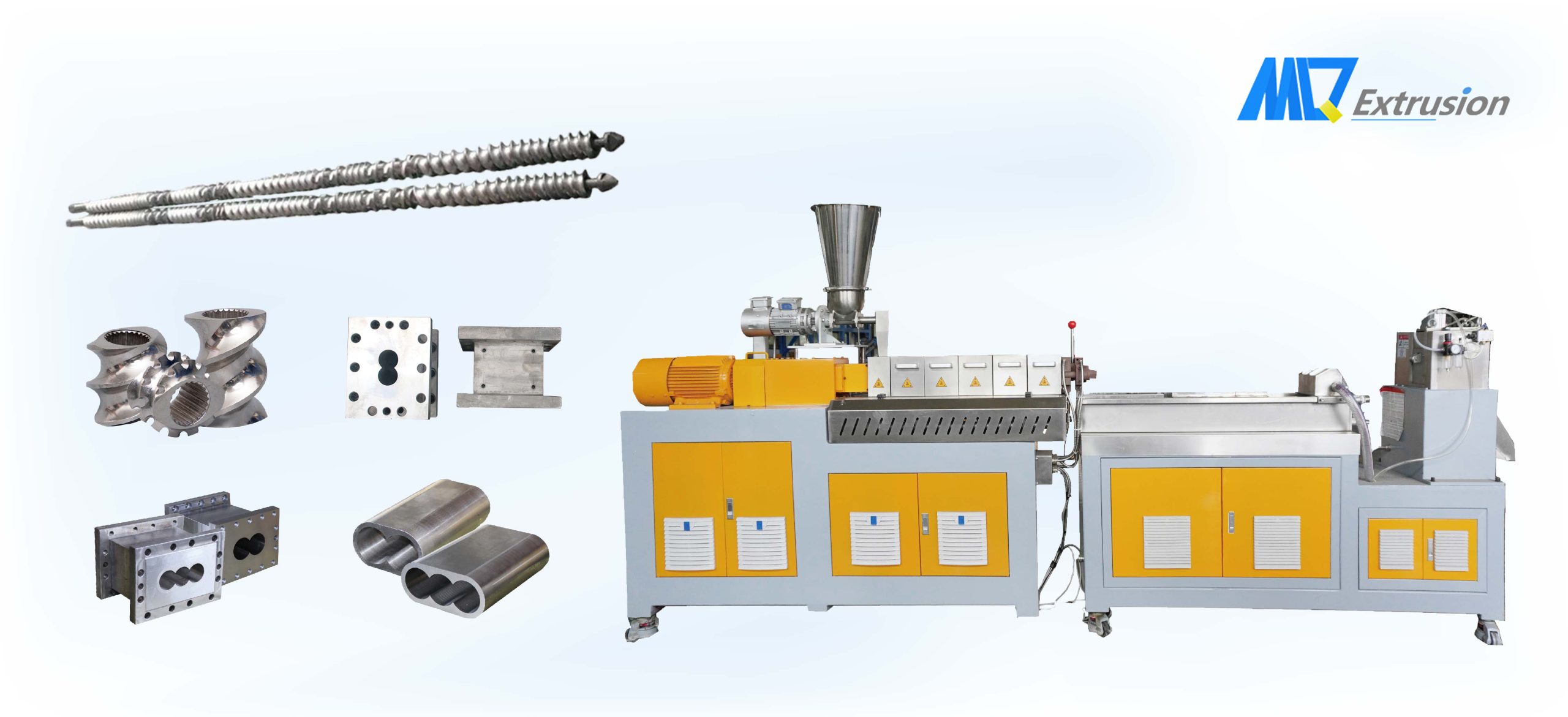
Laboratory Twin Screw Extruder Barrel Segments: Can be individually configured with electrical heating and liquid cooling (water or oil). Openings can be placed along the barrel for solid side-feeding, liquid injection, or vacuum venting.
Screw Elements: Slides onto a spline shaft, allowing the operator to customize the screw configuration. Standard config zones include:
- Conveying Elements: Wide-flighted elements used to transport solid materials forward under low pressure.
- Kneading Blocks: Disks offset at various angles (,,, or ) to provide intensive dispersive mixing (breaking up particles) and distributive mixing (homogenizing components).
- Reverse Conveying Elements: Used to build dynamic locks and local pressure zones to ensure complete barrel fill and enhanced shear.
Crucial Operational Metrics
- L/D Ratio (Length-to-Diameter): Typically ranges from to in standard labs. Longer L/D ratios allow for multiple processing zones (such as feeding, melting, liquid injection, venting, and pressurized discharging) within a single pass.
- Specific Mechanical Energy (SME): Characterizes the thermodynamic energy transferred to the polymer melt by mechanical shear: where is the screw speed (RPM), is the motor torque (Nm), and is the feed rate (kg/h). Controlling SME prevents polymer degradation.
- Residence Time Distribution (RTD): The duration for which the material remains in the extruder. RTD must be closely managed to protect heat-sensitive additives or Active Pharmaceutical Ingredients (APIs).
Primary Applications
Laboratory twin screw extruders serve several highly specialized industries, where precise micro-scale testing dictates commercial success.
A. Polymer Compounding & Material Science
The compounding of engineering plastics involves dispersing functional additives into a polymer matrix. Typical research activities include:
- Nanocomposites: Exfoliating nanoclays, graphene, or carbon nanotubes to enhance mechanical properties.
- Fiber Reinforcements: Incorporating glass, carbon, or natural fibers into polymers without over-shearing and breaking the fibers.
- Polymer Alloying: Homogenizing immiscible polymer phases (such as PA/ABS or PP/EPDM) using compatibilizers.
B. Pharmaceutical Hot-Melt Extrusion (HME)
Under FDA GMP and USP regulatory frameworks, laboratory-scale HME is used to formulate solid dispersion drug delivery systems.
- Solubility Enhancement: Dispersing poorly water-soluble APIs (BCS Class II and IV drugs) within a hydrophilic polymer carrier (such as Copovidone, Soluplus, or HPMCAS) at a molecular level to form an amorphous solid dispersion (ASD).
- Controlled & Sustained Release: Modulating the release profile of implants, transdermal systems, or oral dosages.
C. Foods, Feed, and Bioplastics
Extrusion acts as a continuous bioreactor for starch gelatinization, protein denaturation, and texturization:
- Textured Vegetable Proteins (TVP): Developing meat analogues using plant-based soy, pea, or wheat proteins.
- Biopolymers: Blending bio-derived and biodegradable materials like PLA, PHA, and thermoplastic starch (TPS) with plasticizers to improve tensile properties.
Frequently Asked Questions (FAQ)
What is the typical throughput of a laboratory twin screw extruder?
A laboratory twin screw extruder typically processes between (for micro-compounders) and up to (for standard to sizes). This low throughput minimizes the waste of expensive test components, polymer additives, or proprietary active pharmaceuticals during formulation trials.
Why is co-rotating twin screw extrusion preferred over single screw extrusion for compounding?
Co-rotating twin screw extruders provide superior distributive and dispersive mixing due to the intermeshing action of the screws. Single screw extruders rely solely on channel flow and low shear, which is insufficient for dispersing fillers, pigments, or chemical additives uniformly into a polymer melt. Furthermore, twin screw extruders are self-cleaning and offer precise, independent control over shear rates and residence time.
What can MQ do for customers?
About the laboratory twin screw extruder, starting from mechanical design, it includes equipment manufacturing and production, as well as formulation and processing technology support. Of course, on-site installation and employee training are optional.