How to clean the screw of a twin-screw granules extruder?
In the production process of modified plastics, screw cleaning is a key link to ensure product quality(clean the screw of a twin-screw granules extruder). Residual carbides, pigments, or contamination between different materials can cause defects such as black spots and stripes in the product, resulting in significant losses.
Resin cleaning
The resin cleaning method is a commonly used method for cleaning machines using polyester resin, epoxy resin, or specialized screw cleaning agents, and is suitable for daily maintenance and cleaning.
And the simplest one is to fill the masterbatch with 80% CoCO3 for cleaning, which is low-cost and efficient.
Operation process:
- Reduce the screw speed to 15-25r/min and decrease the feeder speed.
- Set all heating zones of the barrel to the melting temperature (e.g., PET: around 270 ℃)
- Stop feeding, empty the material, and stop the rotation of the twin-screw extruder screw
- Open the mold head, rotate the screw, remove the orifice plate, and discharge the residual washing material from the barrel.
- Strictly follow the recommended temperature settings to avoid resin degradation caused by excessive temperature.
- By observing the color change of the extruded material strip, the degree of cleaning can be determined to ensure complete conversion.
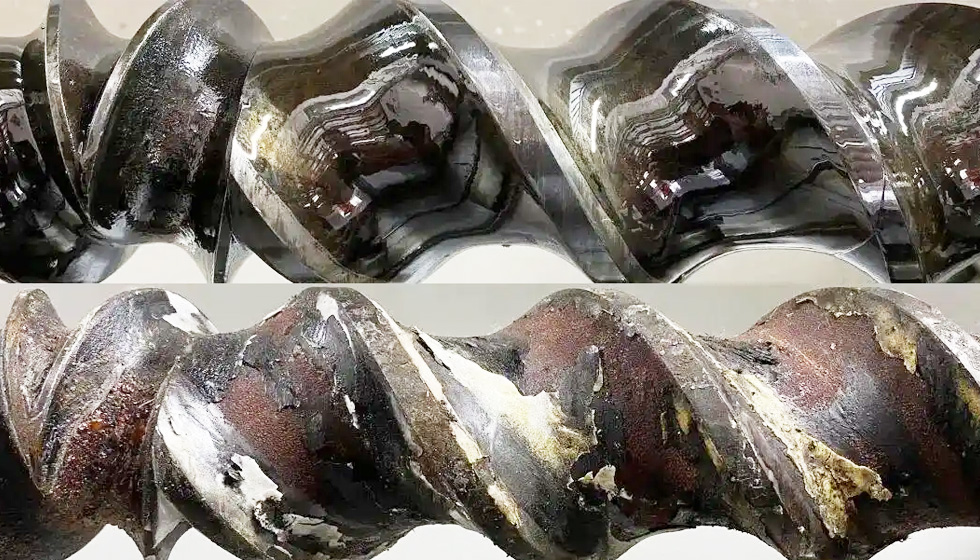
Disassembly and cleaning
The disassembly and cleaning method involves completely disassembling the extruder components for thorough manual cleaning and is suitable for situations that require deep cleaning or replacement of special materials.
Operation process:
- Stop the screw rotation, open the extruder die, and start gradually disassembling.
- Pull out the screw and use specialized tools such as copper scrapers and brushes to prevent damage to the screw and barrel; Ensure that all residues on the surface of the components are removed, especially in the threaded and clearance areas.
- Reinstall the screws in the correct order, install the orifice plate and mold head, and complete the entire cleaning operation.
- Check all seals to ensure assembly accuracy and equipment sealing.
Fire baking and cleaning
The fire baking cleaning method is a traditional method that uses high-temperature flames to directly remove stubborn plastic residues on the surface of screws, and is widely used in plastic processing units.
Operation process:
- Clean the screw immediately after use, as it contains residual heat from the machining process, which is evenly distributed.
- Uniform heating: Keep the flame moving to ensure even heating of the screw and avoid local overheating
- It is strictly prohibited to use acetylene flame: the temperature of the acetylene flame can reach 3000 ° C, which will damage the metal properties of the screw and significantly affect the mechanical tolerance
- Localized overheating causes the screw to bend and deform. It is recommended to clean quickly while moving.
Washing cleaning
The water washing cleaning method utilizes hydraulic rotational energy to achieve comprehensive cleaning of screws, which is an environmentally friendly and efficient modern cleaning solution.
********
Regardless of the cleaning method, adding CaCo3 filling masterbatch in advance can help prevent resin detachment and cleaning. Finally, manual intervention cleaning can save labor time and improve efficiency.
MQ provides professional CaCo3 masterbatch and equipment, and provides on-site installation and training.