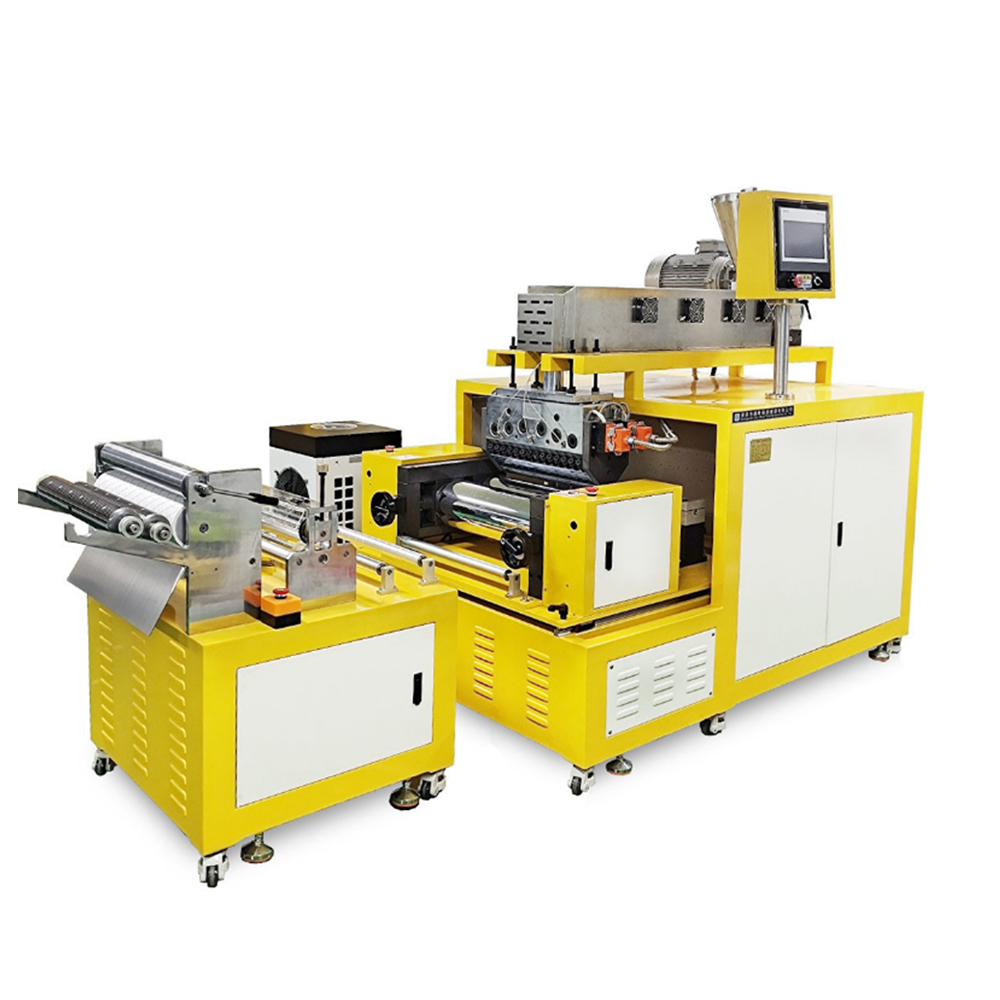
- Rapid cooling and solidification prevent the melt from crystallizing and growing, thus “locking” it into a low haze structure, which complements the transfer effect of the mirror roller.
- For applications that have stringent requirements for “appearance”, such as high-transparency packaging films, optical protective films, and medical dressing base films, the casting process is the only solution.
Strong adaptability to materials
- From general-purpose plastics such as PE and PP to engineering plastics like PET and TPU, and from petroleum-based raw materials to fully biodegradable PLA and PBAT, small cast film machines are all capable of handling them.
Micro-dosing saves raw materials.
- Compared to the startup volume of hundreds of kilograms for large-scale casting lines, a small machine can complete a complete casting experiment starting with just 5kg.
- For high-value formulations containing nano-fillers and functional additives, the material cost savings achieved in each experiment are considerable.
Intelligent Control
- The entire machine is controlled by a PLC touch screen, allowing real-time setting and monitoring of parameters such as extrusion speed, temperature of each section, casting line speed, and cold roller temperature.
- Some models support data collection and export, making every startup an accumulation of process experience, rather than a repetitive trial and error.
Traction and rewinding
- The casting line speed ranges from 0 to 8m/min with stepless speed regulation. The winding process is controlled by torque motors or magnetic powder clutches to maintain constant tension, ensuring that the film remains wrinkle-free and does not undergo tensile deformation during collection.