What Is a Plastic Extruder Machine and How Does It Work?
De un vistazo
| Artículo | Detail |
|---|---|
| Core function | Converts plastic pellets into continuous shapes via heat, pressure, and a die |
| Key component | Rotating screw inside a heated barrel — single or twin screw configurations |
| Common outputs | Pipes, pipe profiles, sheets, films, tubing, wire coating |
| Typical throughput | Varies widely depending on screw diameter, machine configuration, and material Plastics Industry Association extrusion equipment overview |
| Main plastics processed | PVC, PE, PP, ABS, PS, TPU, nylon |
| U.S. industry context | Plastic extrusion is one of the most common plastic processing methods in U.S. manufacturing, used across construction, packaging, automotive, and medical sectors |
What a plastic extruder is — and what it isn’t
A plastic extruder is not an injection molder, and that confusion costs buyers real money when they spec the wrong equipment. Injection molding fills a closed mold in discrete shots. The extrusion process is continuous: raw material goes in one end, finished profile or film comes out the other, uninterrupted.
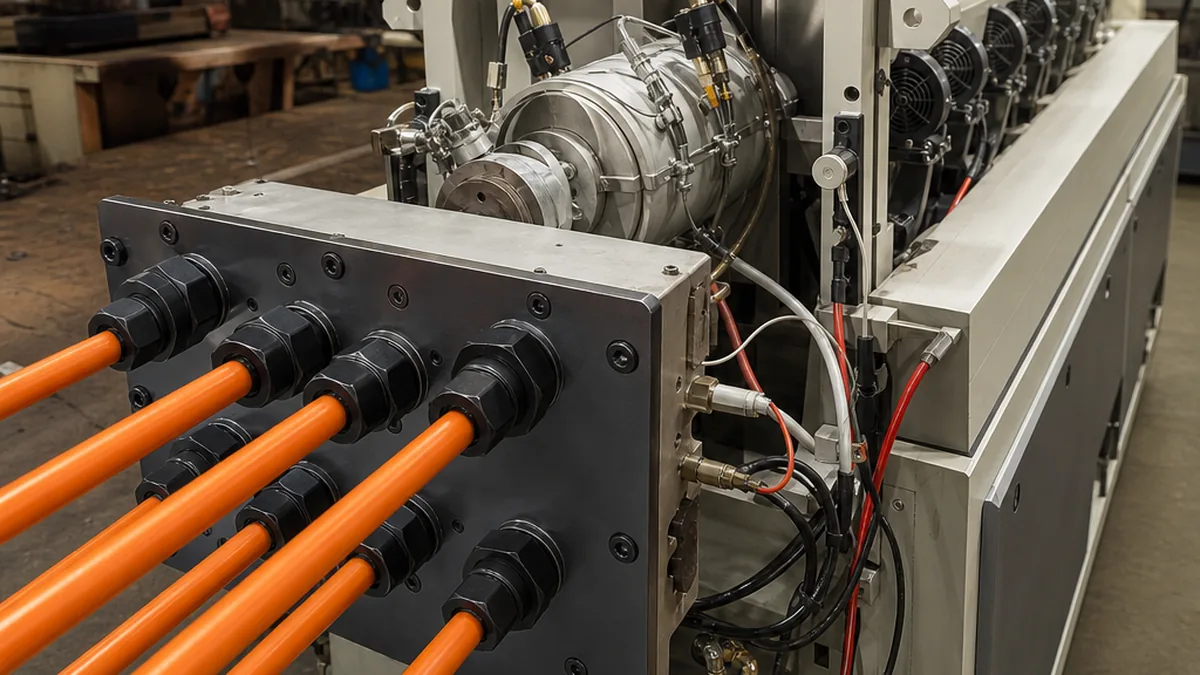
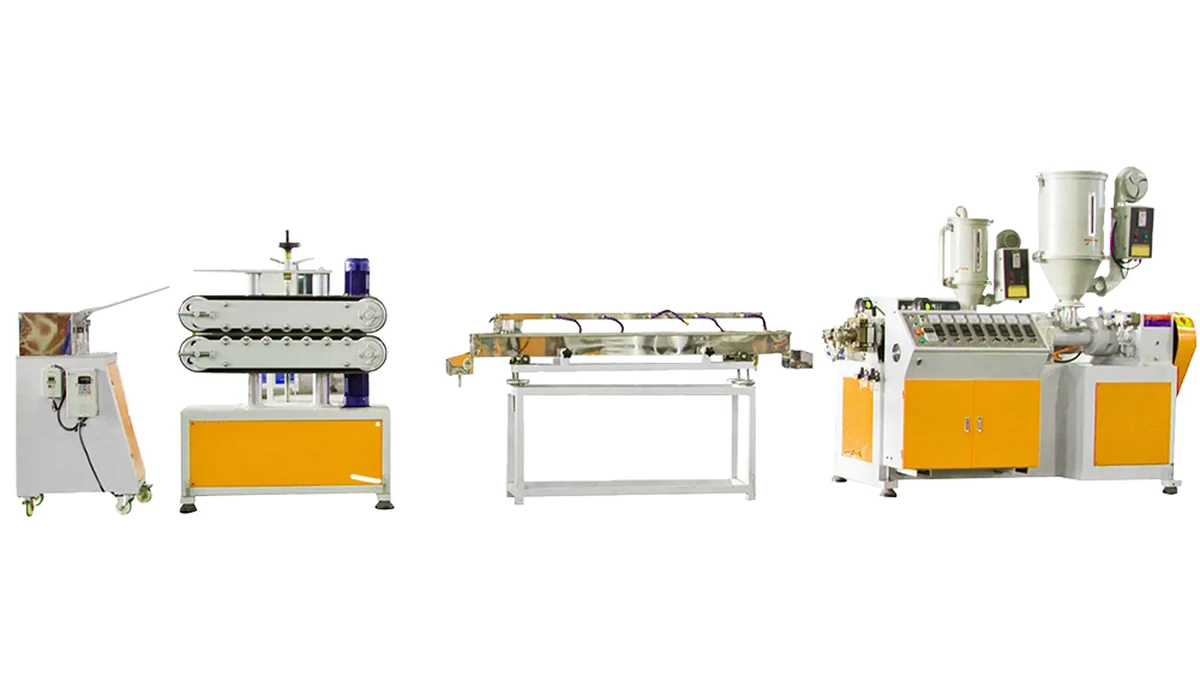
The equipment itself is a system of four integrated stages: a feed hopper, a rotating screw inside a temperature-controlled barrel, a forming die, and a downstream line for cooling and cutting. Each stage does a specific job. None can compensate for a failure upstream — which is why understanding each stage matters before buying or operating.
A common field problem is that buyers size a machine for one material, then switch resins mid-project. The thermal and rheological demands of PVC versus PE differ substantially: PVC’s lower thermal stability[1] means barrel temperatures and residence time must be tightened to prevent degradation, while PE tolerates a broader processing window.
That mismatch is the most common cause of poor output quality on a first production run.
How a plastic extruder works
The mechanism is straightforward once you see it as a pressure-building system.
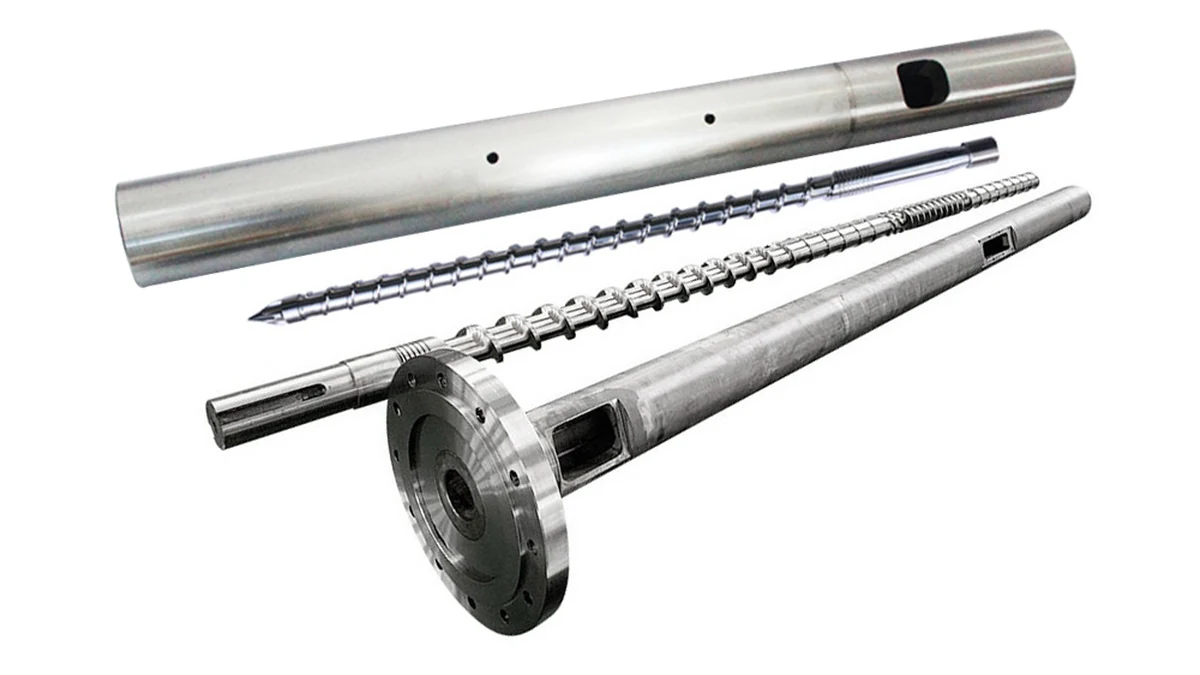
Raw plastic pellets drop from the hopper into the feed zone of the barrel. The rotating screw picks them up and drives them forward through three zones — feed, compression, and metering — each designed to progressively melt and homogenize the plastic. Friction and conductive heat from barrel heaters raise the temperature until the pellets become molten plastic.
That molten material reaches the die under consistent pressure. The die’s opening defines the cross-sectional shape: a ring produces pipe, a flat slot produces sheet, a complex profile die produces window frames or cable trays. Screw geometry — flight depth, compression ratio, pitch — determines how efficiently each material transitions through those zones, which is why flight design is material-specific, not interchangeable.
Immediately after the die, the extrudate enters the cooling section — typically a water bath or air-cooling unit for pipe and pipe profile extrusion lines, or a chill roll stack for sheet and film lines. Calibration tooling holds dimensional tolerance during this phase. A puller then draws the cooled product at a controlled speed, and a cutter or winder finishes the line.
⚠️ Advertencia: Screw speed and barrel temperature must be matched to each plastic’s melt flow index[2]. Running HDPE settings with PVC in the barrel will degrade the material and potentially produce toxic off-gases — always confirm material-specific parameters before startup.
Types of plastic extruders — and when each applies
The decision between machine types hinges on three variables: material complexity, required mixing, and budget.
| Tipo de extrusora | Best for | Mixing intensity | Relative cost |
|---|---|---|---|
| Tornillo único | Commodity resins (PE, PP, PS), pipe, simple profiles | Low–medium | Lower |
| Twin screw (co-rotating) | Compounding, filled materials, PVC dry-blend | Alto | Medium–high |
| Twin screw (counter-rotating) | PVC pipe and pipe profile, rigid compounds | Medio | Medium–high |
| Multi-screw / planetary | High-output PVC, heat-sensitive materials | Very high | Alto |
Single screw extruders handle the majority of commodity plastic extrusion work. They’re reliable, easy to maintain, and well understood. Most pipe extrusion lines and film extrusion equipment in U.S. facilities run on single screw configurations.
Twin-screw extruders are the right call when the material needs intensive mixing — glass fiber compounds, color masterbatches, flame-retardant formulations. Co-rotating twin-screw extruders pull material in the same direction and are suited to high-shear applications such as filled materials. Counter-rotating twin-screw extruders rotate in opposite directions, producing lower shear than co-rotating designs.
That gentler, more controlled mixing is the key advantage for rigid PVC pipe and profile lines, where avoiding thermal degradation matters more than maximizing shear intensity.
Here’s a counterintuitive point worth knowing: twin-screw systems carry a higher purchase price, but for compounded materials they can meaningfully reduce per-unit resin cost by cutting off-spec output. Whether that resin saving is sufficient to offset the capital premium depends heavily on throughput rate, resin price, and the actual off-spec rate achieved — buyers should model this carefully against their own production data before assuming a crossover.
The underlying principle — flight design and compression ratio matched to the actual resin’s melt viscosity (see, for example, ISO 11443 for standardized melt viscosity measurement methods, or consult the OEM process manual for your specific machine)[3] — matters more than machine size in determining output quality. That’s where most specification errors originate.
What plastic extrusion machinery produces
This is where the abstract becomes concrete. The extrusion process underlies more U.S.-manufactured goods than most buyers realize.
Pipe and pipe profile extrusion lines produce the PVC conduit in electrical systems, the HDPE gas distribution pipe installed underground, and the window profiles used across residential construction. Pipe and profile extrusion[4] is one of the largest segments of U.S. plastic extrusion output by volume.
Film extrusion — including blown film and cast film lines — makes stretch wrap, agricultural film, and food packaging film.
Sheet extrusion lines produce thermoformable PETG and ABS sheet that becomes refrigerator liners, point-of-purchase displays, and automotive interior panels. Sheet lines run a flat die and a three-roll chill stack; dimensional tolerance is controlled through roll gap, roll speed differential, and melt temperature. A buyer moving from pipe extrusion into sheet extrusion is not simply adding a die — the downstream equipment, cooling geometry, and process control logic differ substantially.
Wire and cable coating extrusion lines apply insulation and jacketing to copper conductors across electronics and power distribution.
Plastic extruder machine price — what to budget in the U.S. market
Price varies across a wider range than most buyers expect, and the list price is only part of the real cost.
📝 Nota: The figures below are indicative budgeting ranges, not fixed list prices. Actual cost depends on screw diameter, output rate, downstream configuration, and automation level. Always request a detailed quotation against your specific material and pipe profile or sheet geometry.
Chart reading guide: Each bar represents a single reference point from one survey cohort (buyer estimates, 2026) and should be treated as an approximate lower-to-mid estimate for that category, not a typical or average cost. Actual market ranges are wider: small lab single-screw systems can range from roughly $10,000 to $30,000 depending on specification and supplier; production single-screw pipe/profile lines typically start around $55,000 but mid-range configurations commonly run $50,000 to $250,000 or more; the twin-screw compounding figure of $120,000 reflects a small or entry-level system — high-output twin-screw compounding lines can exceed $500,000 to over $1,000,000. These survey cohorts may differ from current list prices; always request current quotations.
Equipment pricing for plastic extruders spans a broad range depending on scale and application. Lab and R&D benchtop units, production-grade pipe or profile lines, and fully automated high-output systems with integrated quality control each occupy substantially different price tiers — buyers should request current quotations from suppliers, as equipment pricing benchmarks[5] vary with specification year and market conditions.
Used plastic extruder machine options can offer meaningful reductions in initial capital outlay, though the actual savings vary widely with machine age, condition, and configuration. The risk is real, though. Worn helical elements and barrel clearances are expensive to restore. Obsolete controls may lack spare parts entirely.
A machine that ran one material for a decade may require a new screw — which can itself represent a significant additional expense — before it runs a different resin reliably. OEM support is typically unavailable for discontinued models. Those hidden costs can substantially narrow the gap between used and new equipment over time, even before counting downtime. Appraisals by a qualified technician before any used purchase are not optional.
Appraisals, repairs, storage, and the total ownership picture
Buyers focused on the purchase transaction often underestimate what happens after the equipment arrives.
Appraisals for used plastic extruder equipment should cover screw and barrel wear (measured as diametral clearance — typically flagged when clearance exceeds the OEM tolerance), heater band condition, gearbox wear, and control system vintage. An appraisal that skips the screw-and-barrel check is incomplete; that’s where the majority of refurbishment cost concentrates.
Independent machinery appraisers certified by organizations such as the American Society of Appraisers[6] [7] offer valuations defensible for financing and insurance purposes.
Repairs on extrusion equipment fall into two categories: scheduled wear-part replacement (feed zone liners, heater bands, thermocouples, drive belts) and unscheduled failure (gearbox, barrel breach, screw breakage). Scheduled maintenance intervals for most single screw systems are documented in the OEM manual and typically run annually for wear checks and every two to three years for gearbox service — though actual intervals depend on throughput hours and material abrasiveness.
Abrasive-filled compounds (glass fiber, mineral-filled PP) accelerate barrel and flight wear significantly compared to unfilled resins.
Storage of idle extrusion equipment requires more than parking it in a warehouse. The barrel should be purged clean and coated internally with a rust-inhibiting compound if the machine will sit for more than a few weeks. Heater bands left energized at low temperature (“frost protection” mode) prevent moisture ingress into electrical components.
Gearbox oil should be changed before storage, not after — used oil carries acids and particulates that accelerate corrosion. Drive systems benefit from periodic rotation (manually turning the screw monthly) to prevent bearing brinelling. Equipment stored improperly for 12–18 months can require a full mechanical inspection before returning to service.
For buyers considering a used equipment purchase, the storage history of the machine is as important as its run hours.
Buying a plastic extruder machine — what to evaluate
The mistake engineers and procurement managers make when sourcing a what is plastic extruder machine evaluation is over-weighting list price and under-weighting application support.
A machine sized and configured for your material, die, and line speed by an experienced team saves weeks of commissioning time. Engineers with over 15 years in the plastic machinery industry — some with up to 28 years of direct extrusion experience — bring screw geometry knowledge that meaningfully reduces first-run commissioning time.
As a general industry caution: specifications locked before the resin rheology and die design are confirmed are consistently the source of first-production-run failures, regardless of machine quality.
When evaluating plastic extruder machine for sale options, ask:
- Is the flight geometry designed for your specific material and output rate, or is it a generic compression ratio?
- Does the manufacturer provide material-specific process parameters (temperature profiles, screw speed, line speed targets)?
- What is the U.S. lead time for replacement screws and barrels?
- Does the price include commissioning support and operator training, or are those billed separately?
Whether you’re sourcing a small plastic extruder machine for sale for R&D or specifying a full pipe extrusion line, those four questions reveal total cost of ownership more reliably than the spec sheet alone.
MQ has served over 300 customers across more than 40 countries. That customer base spans pipe and profile producers, sheet extrusion operations, and compounding lines — the integrated R&D-to-mass-production service model means a U.S. buyer gets application engineering support from the same team that built the equipment, rather than routing commissioning questions through a regional distributor who wasn’t present at manufacture.
For buyers comparing plastic extruder machine manufacturers on capability and price, request a detailed application review before committing to any configuration.
Extrusion line operators — the human side of the process
Is extrusion operator a good job? The U.S. Bureau of Labor Statistics[8] publishes wage data for plastics and rubber machine workers that can serve as a general reference point; readers should consult the most current BLS Occupational Employment and Wage Statistics release and their local labor market data directly, as figures vary by region, employer, and experience level. Experienced setup technicians and process engineers typically earn considerably more than entry-level operators. The work is technical, structured, and physically manageable compared to heavy fabrication trades.
Advancement paths — from operator to setup technician to process engineer — are well defined in most production environments.
¿Tienes un proyecto o una ficha técnica? Ponte en contacto con mqextrusion.com: te atenderán ingenieros de verdad.
Preguntas frecuentes
What is the purpose of an extruder?
A plastic extruder melts raw plastic pellets and pushes the molten material through a die to create continuous shapes with a consistent cross-section. Manufacturers use extruders to produce pipes, tubing, window profiles, wire insulation, plastic film, and sheet stock. The machine delivers high-volume, repeatable output at relatively low cost per pound compared to other plastic-forming processes, making it the backbone of most plastic profile and packaging production lines in the United States.
What is an example of a plastic extrusion?
PVC window frames are one of the most common plastic extrusion examples found in American homes. The extruder forces molten PVC through a die shaped exactly like the finished frame profile, producing a continuous length that is then cut to size. Other everyday examples include garden hoses, plastic grocery bags, corrugated drainage pipe, drinking straws, and the insulation coating on electrical wire.
How much does a plastic extruder cost?
Typical throughput varies widely depending on screw diameter, machine configuration, and material. High-output twin-screw extruders for compounding or specialty film lines can exceed $500,000 to over $1 million fully configured. Price depends on screw diameter, output rate, drive power, controls sophistication, and any downstream equipment such as cooling tanks, pullers, and cutters included in the line.
Fuentes
[1] D1784 Standard Classification System and Basis for… — store.astm.org
[2] D1238 Standard Test Method for Melt Flow Rates… — store.astm.org
[3] SPE Screw Design Conference-Topcon — spescrewdesigntopcon.technical-content.com
[4] Member Resources — plasticsindustry.org
[5] Latest Issue — ptonline.com
[6] Machinery & Technical Specialties (MTS) — appraisers.org
[7] Heavy & Construction Equipment Appraisals — allequipmentappraisal.com
[8] Photographic Process Workers and Processing Machine… — bls.gov