A Small Film Machinery: Revolutionizing R&D and Specialized Plastic Production
In the rapidly evolving world of polymer science, the ability to test, iterate, and produce in small batches has become a critical competitive advantage. While massive industrial extrusion lines dominate mass production, there is a surging global demand for small film machinery—compact, high-precision equipment designed for laboratories, startups, and specialized niche manufacturers.
Whether you are testing a new biodegradable resin or producing high-value medical-grade films, a small film machine provides the flexibility and cost-efficiency that industrial-scale machines simply cannot match.
What is A Small Film Machinery?
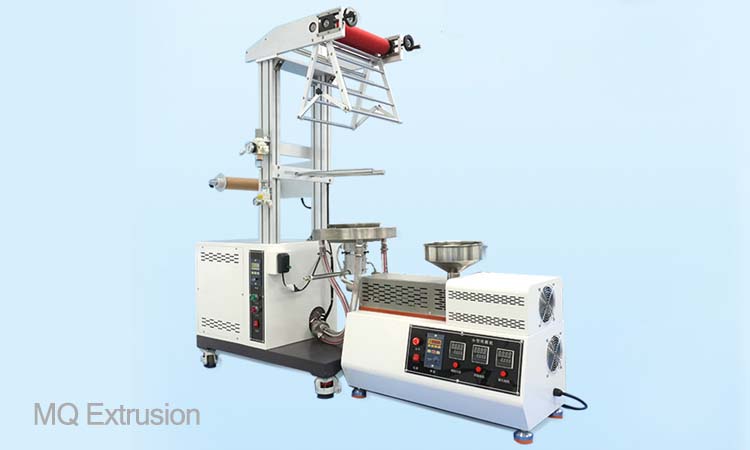
A small film machinery (often referred to as a laboratory or desktop blown film line) is a scaled-down version of industrial film extrusion equipment. Despite its compact footprint, it performs the full cycle of plastic film manufacturing:
- Melting: Heating raw polymer pellets in a small-bore extruder.
- Blowing: Forcing the melt through a circular die to create a thin “bubble” of plastic.
- Cooling: Using air rings to solidify the bubble.
- Winding: Flattening the bubble into a double-layered film and winding it onto a roll.
The Strategic Advantages of Small-Scale Film Equipment
Why are global research centers and manufacturers investing in small film machinery? The benefits go far beyond just saving floor space:
1. Drastic Reduction in Material Waste
Industrial machines require hundreds of kilograms of resin just to reach a stable operating state. In contrast, a small film machine can operate with as little as 500g to 1kg of material. This is vital when working with expensive experimental polymers or rare additives.
2. Rapid Prototyping and R&D
In a research setting, speed is everything. Small machinery allows engineers to change resin formulations, adjust temperatures, and modify blow-up ratios (BUR) in minutes rather than hours. This acceleration of the “fail-fast” cycle is essential for modern material innovation.
3. Low Energy Consumption and Setup Cost
A small film machinery typically runs on standard single-phase or three-phase power and requires significantly less cooling water and electricity than its industrial counterparts. For startups or educational institutions, the lower initial capital expenditure (CAPEX) makes advanced plastic manufacturing accessible.
4. Precision and Control
Modern small-scale machines are equipped with advanced PLC (Programmable Logic Controller) systems. Because the volume of material is smaller, operators have much tighter control over thermal gradients and pressure stability, leading to highly consistent film thickness and quality.
Comparing Industrial vs. Small Film Machinery
| Feature | Large Industrial Film Line | A Small Film Machinery |
| Output Rate | 100 – 500+ kg/hr | 0.5 – 5 kg/hr |
| Material Requirement | Very High (Startup waste) | Minimal (Ideal for testing) |
| Footprint | 50 – 200+ Square Meters | 2 – 5 Square Meters |
| Changeover Time | 2 – 8 Hours | 15 – 30 Minutes |
| Primary Use | Mass Production (Bags, Wraps) | R&D, Masterbatch Testing, Niche Films |
Key Applications of Small Film Machinery
The versatility of small film machinery allows it to serve various high-tech sectors:
- Biodegradable Resin Development: Testing the “blowability” and tensile strength of new starch-based or PLA-based bioplastics.
- Color Masterbatch Testing: Evaluating how well a specific pigment or additive disperses within a polymer matrix before moving to full-scale production.
- Medical and Pharmaceutical: Producing small runs of specialized high-barrier films for medical packaging or specialized laboratory use.
- Education and Training: Providing students and new engineers with hands-on experience in the physics of polymer extrusion without the risks and costs of large-scale machinery.
Technical Components to Look For
When selecting a small film machine, certain components define the machine’s capability:
- The Screw & Barrel: Look for high-grade nitrided steel or bimetallic treatment to handle abrasive additives.
- The Die Head: A precision-engineered spiral mandrel die ensures uniform melt distribution.
- Air Ring Design: High-efficiency cooling is critical for maintaining bubble stability at small scales.
- The Take-up Unit: Adjustable height and speed allow for the production of films with varying thicknesses and widths.
Conclusion: Small Scale, Big Impact
While “big” usually gets the headlines in manufacturing, small film machinery is often where the most significant breakthroughs occur. By providing a cost-effective, precise, and fast environment for polymer experimentation, these compact machines are the unsung heroes of the circular economy and advanced material science.
If your facility is looking to optimize its R&D workflow or enter the niche film market, investing in high-quality small film machinery is the logical first step toward future-proofing your production capabilities.
Are you looking for custom-engineered small film machinery for your laboratory or production facility?
Contact our technical equipment specialists today for a quote and learn how our compact extrusion solutions can accelerate your polymer research.
Nota: El artículo se basa en:Plastics Engineering & Laboratory Technology Review