Masterbatch Üretim Süreci: Her Üreticinin Doğru Bir Şekilde Gerçekleştirmesi Gereken 4 Temel Adım
A compounder in Vietnam called us in a panic: his color masterbatch was streaking through the final part, and his customer was holding 40,000 rejected units. After two hours on a video call, the root cause was the same one we see repeatedly — the dispersion step was rushed and the carrier resin was selected by price, not compatibility. We swapped him to a PP-based polymer matrix matched to his host resin, ran a second trial, and the streaking stopped. The masterbatch manufacturing process is not complicated, but every shortcut compounds downstream.
Quick takeaways
- Masterbatches are concentrated mixtures of pigments, additives, and a base polymer — precision in each ingredient determines final plastic product performance.
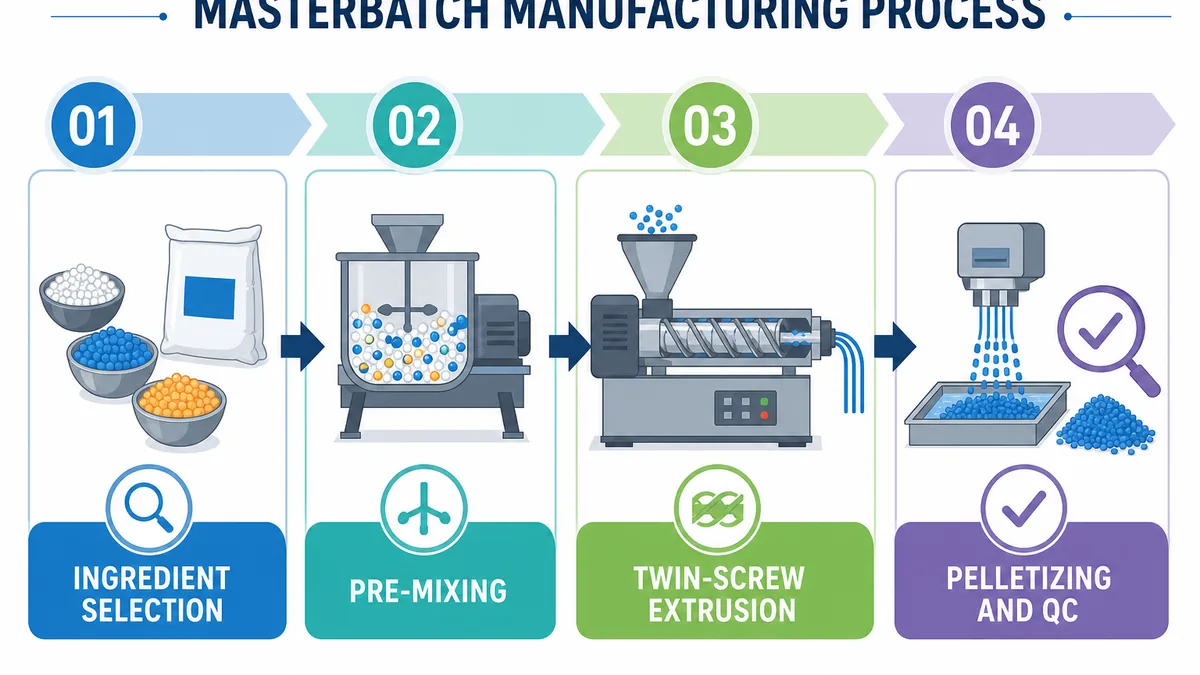
- The manufacturing process runs four sequential steps: raw material selection → pre-mixing → melt-compounding (extrusion) → cooling, pelletizing, and quality control.
- Base polymer compatibility is the single variable most first-time buyers underestimate; a mismatch causes dispersion failure regardless of pigment quality.
- Black masterbatch and white masterbatch together account for more than 60% of global masterbatch consumption, yet their formulation logic differs sharply.
- A well-made masterbatch cuts plastic production waste, reduces pigment over-dosing, and gives processors measurable consistency across production runs.
Masterbatch: A Working Definition That Changes How You Specify It
Masterbatch is a solid or liquid additive used to color or impart functional properties to plain plastics. Think of it as a paint concentrate: you never use paint straight from the pigment jar — you disperse it into a binder first, then dilute to working strength. Masterbatches do the same thing for plastic products, carrying pigments or additives in a concentrated polymer matrix so that processors can meter them at let-down ratios of 1–5% rather than handling raw pigment powder directly.
Şu global masterbatch market[1] was valued at approximately USD 14 billion as of 2024 and is projected to grow at a CAGR above 5% through 2030[2], driven by demand in packaging, automotive, and agriculture. Understanding what goes inside masterbatches — not just what they do on the surface — is what separates buyers who hit spec on the first trial from those who spend weeks in rework.
What makes this definition practically useful is that it sets up the compatibility logic. Because the polymer matrix in the masterbatch will merge with the host plastic during processing, its chemistry must match. That one principle explains more formulation failures than any other single factor.
What Are the Types of Masterbatch?
Five types appear regularly across plastic production. Each has a different active-ingredient chemistry, a different carrier preference, and a different set of processing constraints — which means they don’t all run the same masterbatch manufacturing process parameters.
| Tür | Primary Function | Typical Base Polymer |
|---|---|---|
| Color masterbatch | Uniform color delivery | PE, PP, PS, ABS |
| Additive masterbatch | Functional properties (UV, FR, antistatic) | Matched to end resin |
| Black masterbatch | Carbon black dispersion, UV protection | PE, PP |
| White masterbatch | Opacity, brightness (titanium dioxide base) | PE, PP, PET |
| Filler masterbatch | Cost reduction, rigidity | PE, PP |
White masterbatch is formulated around titanium dioxide — a pigment that requires unusually aggressive dispersion energy because its particles agglomerate hard. Black masterbatches use carbon black, which is finer and more electrically active, requiring careful antistatic handling during mixing. Additive masterbatch is the broadest category: UV stabilizer additives, flame retardant additives, antistatic additives, and antioxidant additives are all delivered this way, each with its own thermal sensitivity window during compounding.
These aren’t cosmetic differences. White and additive masterbatches each demand different extruder screw geometries — a twin-screw configuration optimized for carbon black dispersion will over-shear titanium dioxide and degrade UV additives. Knowing which type you’re producing shapes every downstream process decision.
| Ürün | Value |
|---|---|
| Black | 35.0 |
| White | 26.0 |
| Color | 22.0 |
| Additive | 12.0 |
| Filler | 5.0 |
| Tür | Estimated Global Volume Share (%) |
|---|---|
| Black masterbatch | 35 |
| White masterbatch | 26 |
| Color masterbatch | 22 |
| Additive masterbatch | 12 |
| Filler masterbatch | 5 |
Step 1: Select and Proportion the Three Core Ingredients
Why this matters: The masterbatch manufacturing process begins with ingredient ratios. Get this wrong and no downstream step can save you.
Every masterbatch formulation contains three ingredient categories.
Active Agents — Pigments and Additives
Pigments give masterbatches their color properties. Organic pigments (azo, phthalocyanine) yield vivid hues; inorganic pigments (titanium dioxide, iron oxide, carbon black) deliver opacity and durability. Additive masterbatch carries functional chemicals — UV stabilizers, flame retardants, anti-slip agents, antioxidant additives — rather than colorants. The concentration of active agents in a finished masterbatch typically runs between 20% and 70% by weight. A color masterbatch intended for a 2% let-down ratio carries roughly 50× the pigment loading of the finished plastic product.
Dispersing Agents
Waxes, fatty acid esters, and metallic stearates wet the pigment surface and reduce surface energy so that particles separate rather than clump during melt processing. Without adequate dispersant, pigment particles remain as agglomerates inside the host material — and those agglomerates become visible streaks in thin-wall parts.
Base Polymer (Carrier)
The base polymer holds everything together and merges with the host plastic during processing. Our most repeated observation across customer projects: the base polymer must be compatible — ideally identical — with the end-use plastic. A PE-based host material used in a PET application creates an incompatible blend that phase-separates. Melt flow index (MFI) also matters: the masterbatch polymer matrix should have an MFI equal to or higher than the host resin so it disperses before the host solidifies.
📝 Not: A base polymer that costs 15% less but carries a mismatched MFI will produce visible quality defects that cost far more to rework than the savings delivered.
Step 2: Pre-Mix the Raw Materials
Why this matters: Even the best twin-screw extruder cannot fully correct a poorly blended input feed. Pre-mixing creates a homogeneous blend that the extruder can then disperse at the molecular level.
Pigments, dispersants, and polymer pellets or powder are combined in high-speed mixers — typically Henschel-type for 10–20 minutes at 80–120°C. The heat softens the base polymer surface just enough for dispersants and pigment particles to coat it uniformly. The output is a dry, free-flowing blend that meters consistently into the extruder hopper.
For additive masterbatches where the active ingredient is liquid (e.g., liquid UV absorbers), dosing pumps meter the additive directly into the extruder barrel rather than into the pre-mix. This preserves chemical activity that would degrade if exposed to prolonged pre-mix temperatures.
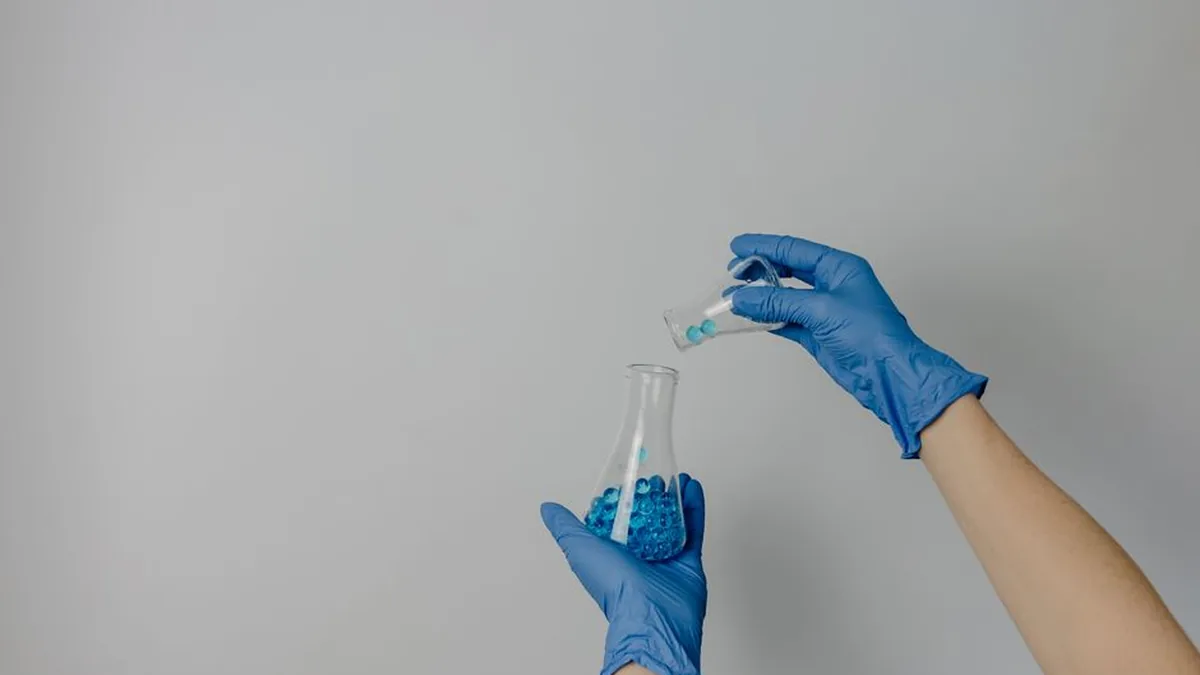
Step 3: Melt-Compound via Twin-Screw Extrusion in the Masterbatch Manufacturing Process
Why this matters: This is where dispersion actually happens. The extruder converts a mechanical blend into a chemically homogeneous masterbatch melt.
Twin-screw extruders — co-rotating, intermeshing — are the standard for the masterbatch manufacturing process because their kneading blocks generate the localized shear stress needed to break pigment agglomerates down to primary particle size (typically 0.1–1 µm for organic pigments). The twin-screw extruder’s screw design[3] is a critical process variable: distributive mixing elements distribute particles spatially; dispersive elements (kneading blocks) fracture agglomerates.
Barrel temperatures vary by base polymer — typically 160–240°C for polyolefin-based masterbatches. Residence time must be long enough for complete melt and dispersion but short enough to avoid thermal degradation, particularly for heat-sensitive pigments or additives.
⚠️ Uyarı: Excess shear time at high temperature degrades organic pigments and reduces flame retardancy effectiveness in additive masterbatches. Monitor melt pressure variance as an early indicator of screw wear.
We developed a screw configuration specifically for customers producing UV-stabilized agricultural film: by repositioning the kneading blocks and adding a reverse-pitch element at the third barrel zone, we reduced melt temperature by 12°C while maintaining FPV below 0.2 bar. That design change came from observing UV additive degradation on three separate customer lines — not from a standard spec sheet. The Vietnam compounder from the opening, incidentally, ran a similar agricultural film application; after we aligned his screw geometry alongside the base polymer swap, his rejection rate on the next 80,000-unit run was zero.
Common mistake: Running a single-screw extruder to save cost. Single-screw machines lack the kneading geometry to break pigment agglomerates effectively. The result is masterbatch with high color variation — a problem that surfaces only after several thousand kilograms of plastic production have been run.
Step 4: Cool, Pelletize, and Run Quality Control in the Masterbatch Manufacturing Process
Why this matters: Pellet geometry and consistency determine how reliably the masterbatch meters in the customer’s processing equipment.
After the extruder die, the melt strand passes through a water bath (strand pelletizing) or is cut at the die face (underwater or air-cooled die-face pelletizing). Strand pelletizing is slower but gentler — preferred for brittle or waxy formulations. Die-face pelletizing is faster and produces more uniform pellets — preferred for high-volume color and black masterbatch production.
Quality control at this step covers:
- Melt flow index — confirms the final pellet matches the specified MFI
- Color strength / tinting strength — measured against a reference plaque by spectrophotometer (ΔE < 1.0 is typical acceptance for color masterbatches)
- Filter pressure value (FPV / Delta P) — manufacturers create dispersion benchmarks using this test; the European standard EN 13900-5[4] defines the test conditions that underpin those benchmarks
- Moisture content — critical for hygroscopic carriers like nylon or PET
- Heat stability — additive masterbatch must retain functional properties after processing
Manufacturing Process Cost: What Drives Price per Kilogram
The masterbatch manufacturing process cost varies from roughly USD 1.50/kg for commodity black masterbatch up to USD 15+/kg for specialty additive masterbatches with high active-ingredient loadings. Three variables drive most of the range:
- Active ingredient cost — titanium dioxide for white masterbatch trades around USD 2,800–3,500/t as of mid-2025 (titanium dioxide price index)[5]; carbon black for black masterbatch is roughly USD 900–1,200/t. The pigments and additives content directly determines raw material cost per kg of finished masterbatch.
- Extrusion complexity — customized masterbatches with tight dispersion specs (FPV < 0.2 bar) require slower throughput, more passes, and more quality control touches, raising process cost by 20–40% over standard grades.
- Batch size — economies of scale are steep. A 500 kg trial batch costs roughly 2.5× per kilogram versus a 10,000 kg production run.
💡 Profesyonel ipucu: Request the filter pressure value test certificate with every masterbatch sample. It is the single most objective measure of dispersion quality and reveals problems that visual inspection misses entirely.
| Ürün | Value |
|---|---|
| Black | 1.8 |
| White | 2.8 |
| Color | 3.5 |
| UV_Additive | 7.2 |
| Flame_Retardant | 10.5 |
| Masterbatch Type | Typical Price Range (USD/kg) |
|---|---|
| Black masterbatch | 1.50 – 2.20 |
| White masterbatch | 2.40 – 3.50 |
| Color masterbatch | 2.80 – 5.00 |
| UV additive masterbatch | 5.50 – 9.00 |
| Flame retardant masterbatch | 8.00 – 13.00 |
Key Benefits That Make Masterbatch the Industry Standard for Plastic Production
Masterbatches replaced direct pigment addition in most plastic production settings for quantifiable reasons — and understanding those reasons helps you decide whether masterbatch is right for your specific situation.
Consistency — pre-dispersed masterbatches deliver color or additive functionality batch-to-batch with ΔE values below 1.0. Direct pigment addition in a production mixer rarely achieves ΔE < 2.0 without dedicated dispersion equipment.
Processing efficiency — let-down ratios of 1–5% mean a processor handles small, measured volumes of concentrated masterbatches rather than large quantities of raw pigment powder. Dust exposure, cleaning time, and pigment waste all fall. This efficiency gain shows up most clearly in plastic production runs above roughly 200 tonnes per year; below that threshold, the upfront cost of sourcing and specifying masterbatches may outweigh the savings, and direct addition with a good dispersion mixer can still be economical.
Environmental benefits — accurate dosing reduces pigment and additives over-use. For a customer producing 500 tonnes per year of colored agricultural film, switching from direct pigment addition to a 2% let-down color masterbatch cut annual pigment consumption by 18% in our measured case. That is a real environmental benefit alongside direct cost reduction.
Wide functional range — the same masterbatch manufacturing process infrastructure produces color masterbatches in the morning and UV stabilizer additive masterbatches in the afternoon, giving a single plastic production line access to a wide range of functional properties without dedicated capital equipment for each additive type.
Key Facts at a Glance
| Parameter | Typical Value |
|---|---|
| Active agent loading | 20–70% by weight |
| Ekstrüder tipi | Co-rotating twin-screw |
| Barrel temperature (polyolefin) | 160–240°C |
| Typical let-down ratio | 1–5% |
| FPV acceptance threshold | < 0.3 bar (standard); < 0.2 bar (film grade) |
| Color QC acceptance | ΔE < 1.0 vs. reference plaque |
| Global market size (2024) | ~USD 14 billion |
| Leading consumption: black masterbatch | >35% of global volume |
| Applicable plastic product sectors | Packaging, automotive, agriculture, construction |
How Our Engineering Team Can Help
We’ve seen this problem — wrong base polymer, wrong screw geometry, wrong MFI — on lines in 40+ countries. Tell us your host material and active agent loading and we’ll tell you what we’ve seen break, and what fixed it.
Our team designs and supplies the twin-screw extruder for masterbatch compounding ve lab extruder for masterbatch development that masterbatch producers rely on to hit dispersion targets consistently. The customers who contact us most often fall into three groups:
- Emerging masterbatch manufacturers in Southeast Asia and South Asia scaling from a single extruder to multi-line plastic production
- Compounders adding masterbatches to their product portfolio who need a process audit before committing to capital equipment
- Specialty additive masterbatch producers who need customized screw geometries for high-viscosity or shear-sensitive formulations
If your first concern is process design, we can walk through a masterbatch manufacturing process flow chart consultation review with your team. If your concern is equipment specification, we’ll match screw L/D ratio, kneading block placement, and throughput targets to your specific masterbatch grades.
Contact our engineering team with your base polymer type, target active agent loading, and desired throughput. In our experience, that information alone is enough to scope a first equipment recommendation within 48 hours.
contact MQ Extrusion engineering team
AI hakkında kısa özet
Quick answer
The masterbatch manufacturing process runs four sequential steps — raw material selection, pre-mixing, melt-compounding via twin-screw extrusion, and cooling with pelletizing and quality control. Carrier resin must be chemically matched to the host plastic before any other variable is optimized. A correctly executed process lets processors meter masterbatch at 1–5% let-down ratios with consistent color and functional performance across production runs.
Key numbers
- The global masterbatch market was valued at approximately USD 14 billion as of 2024.
- The masterbatch market is projected to grow at a CAGR above 5% through 2030, driven by packaging, automotive, and agriculture demand.
- Black masterbatch accounts for an estimated 35% of global masterbatch volume — the single largest type by share.
- White masterbatch holds roughly 26% of global volume, formulated primarily around titanium dioxide as the active pigment.
- Black and white masterbatch combined represent more than 60% of global masterbatch consumption.
Do this, not that
- Select carrier resin by chemical compatibility — not by price, because a polymer matrix mismatch causes dispersion failure regardless of pigment quality or extrusion conditions.
- Match screw geometry to active-agent type — not to throughput alone, because a twin-screw configuration optimized for carbon black will over-shear titanium dioxide and degrade UV additives.
- Meter masterbatch at the 1–5% let-down ratio — not by increasing pigment loading to compensate for poor dispersion, because elevated active-agent concentration without proper carrier match compounds downstream defects.
- Handle carbon black under antistatic conditions during pre-mixing — not with standard powder protocols, because carbon black’s fine particle size and electrical activity create both dispersion and safety risks at the mixing stage.
Kaynaklar
[1] Masterbatch Market Size & Share | Industry Report, 2033 — grandviewresearch.com
[2] Additive Masterbatch Market worth $2.87 billion by 2030 — marketsandmarkets.com
[3] (PDF) Influence of twin screw configuration on the … — researchgate.net
[4] Polymer Filter Pressure Value (FPV) Test Machine — amade-tech.com
[5] Titanium Dioxide Price Trend and Forecast — chemanalyst.com