Kilo verme besleyicisinin bakımı ve onarımı nasıl yapılır?
Loss in weight feeders
In the increasingly automated blending production line, loss-in-weight feeders have become standard equipment. It not only determines the accuracy of the ratio of multi-component blends, but also serves as a metronome for achieving continuous production.
In actual operation, problems such as weighing fluctuations, bridge blockage, and signal interference are often encountered.
Why is your ratio not accurate? Today, how can we scientifically maintain the loss in weight feeder?
Problem Analysis
1 Interference from Load Cells
Phenomenon: The feeding amount reading fluctuates violently, or there is a significant deviation curve during the feeding cycle.
Deep analysis: Sensors are extremely precise mechanical measuring components. In the blending workshop, mechanical vibration (roar from the host), airflow disturbance (negative pressure from the dust removal system), and electrostatic interference can all generate false signals.
Solution: A. Soft connection inspection to ensure that the feeder outlet and extruder inlet, as well as the feed pipe and silo, are in a complete “soft connection” state, and hard contact vibration transmission is strictly prohibited.
B.Independent grounding, the sensor shielding wire must be independently grounded to prevent high-frequency interference generated by the frequency converter.
2 Material bridging and fluctuation of screw filling rate
Appearance: The screw speed keeps increasing, but the actual feeding amount is decreasing (empty material).
Deep analysis: This usually occurs in powders or high fiber materials with poor fluidity. The material forms a stable “arch bridge” in the silo, resulting in a serious shortage of Degree of filling in the screw.
Solution: A.Select targeted flow assistance solutions and use a stirring horizontal feeder or install a flexible hopper (massage chamber) for materials that are prone to bridging, instead of simple electromagnetic vibration.
B.Optimize screw type: Choose single screw or twin-screw feeding structure based on material characteristics (such as granular, powdery, flaky).
3 Nonlinear deviation of replenishment cycle (Refill)
Appearance: At the moment when the large material warehouse replenishes the feeder, the production line’s current fluctuates, and the performance indicators of the finished product are unstable.
Deep analysis: The system is operating in a “volumetric” mode during material replenishment and cannot be weighed in real-time. If the feeding speed is too fast, the impact force of the material will cause instantaneous overfeeding; If the packing density of the material changes, it will cause an imbalance in the ratio.
Solution: Optimize the feeding strategy, set reasonable upper and lower limits for feeding, follow the principle of “small quantity multiple times”, and reduce the impact pressure head.
Improve the maintenance system
1 Static and dynamic calibration
Standard: Engineers require zero-point calibration once per shift and weight calibration once a week.
Practical experience: Static code hanging qualification does not mean dynamic accuracy. It is recommended to regularly verify the true accuracy of the system in operation through the “physical capture method” (sampling and weighing).
2 Corrosion and damage prevention of seals and bearings
Modification often involves functional additives (such as coupling agents, flame retardants), some of which are corrosive.
Maintenance: Focus on checking whether the packing of the sealed drive shaft leaks powder. Once dust enters the bearing or gearbox, it will cause an increase in operating resistance, directly interfering with the torque feedback of the control motor.
3 Fatigue detection of flexible connections
The fabric or rubber between the upper and lower parts of the feeder will accumulate powder and harden over time. The hardened soft connection will generate “force coupling”, resulting in serious weighing misalignment. It is recommended to replace the flexible connectors once every quarter.
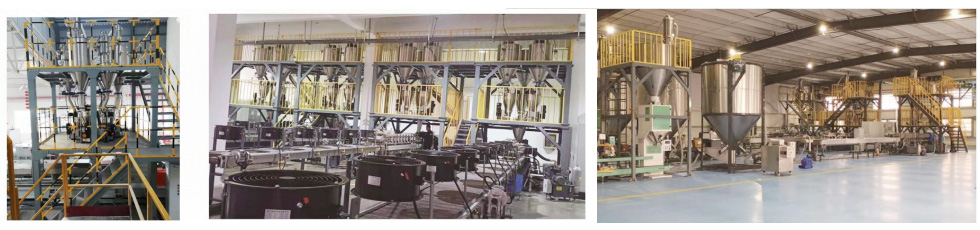
MQ provides a complete set of fully automatic weighing and feeding solutions, starting from the platform, to system testing, and finally to project completion, providing full training services, including on-site installation.
Improve feeding accuracy and achieve peak plastic quality!