3D Printer Filament Recycler: The Ultimate Guide to Closing the Loop in 3D Printing
The boom in 3D printing has completely reformed rapid prototyping, custom manufacturing, and hobbyist workshops. However, this revolution has a silent byproduct: plastic waste. Failed prints, structural supports, rafts, and discarded prototypes collectively contribute to mountains of plastic destined for landfills.
Enter the 3D printer filament recycler—an innovative, cost-saving, and eco-friendly machine designed to turn failed prints and scrap plastics back into high-quality, usable filament.
Whether you operate a high-volume industrial 3D printing lab, a school makerspace, or a busy hobbyist workshop, a filament recycling system lets you close the loop and achieve zero-waste additive manufacturing. Here is your ultimate guide to finding and utilizing the best 3D printer filament recycler.
What is a 3D Printer Filament Recycler?
A 3D printer filament recycler (often consisting of a plastic shredder and a filament extruder) is a desktop or industrial system that processes post-industrial or post-consumer plastic waste, melts it down, and extrudes it back into a precise filament spool (typically 1.75mm or 2.85mm in diameter), ready to be printed again.
How Does a Filament Recycling System Work?
The recycling process involves four primary phases to ensure the final product meets the strict diameter tolerances required by modern fused deposition modeling (FDM) printers:
1. Shredding (Size Reduction)
Before melting, failed 3D prints and support structures are too bulky. A heavy-duty plastic shredder grinds the scrap material into uniform, millimeter-sized plastic flakes or regrind.
2. Drying
Polymers like PLA and PETG are highly hygroscopic, meaning they absorb moisture from the surrounding air. Extruding wet plastic results in bubbling, poor layer adhesion, and a brittle filament. Materials must be dried thoroughly in a dehydrator before extrusion.
3. Melting and Extrusion
The dry plastic flakes are loaded into the hopper of the filament extruder. A rotating screw feeds the plastic through a heated barrel where it liquefies. The molten resin is then pushed through a brass nozzle (usually sized slightly larger than the target diameter to allow for post-stretch cooling).
4. Diameter Control, Cooling, and Spooling
To ensure the recycled filament doesn’t clog your extruder, its diameter must remain within a tolerance of. Modern recyclers use optical laser sensors to measure the filament dynamically, regulating the speed of the puller and spooler to automatically adjust the diameter, cooling the plastic with fans before winding it neatly onto a spool.
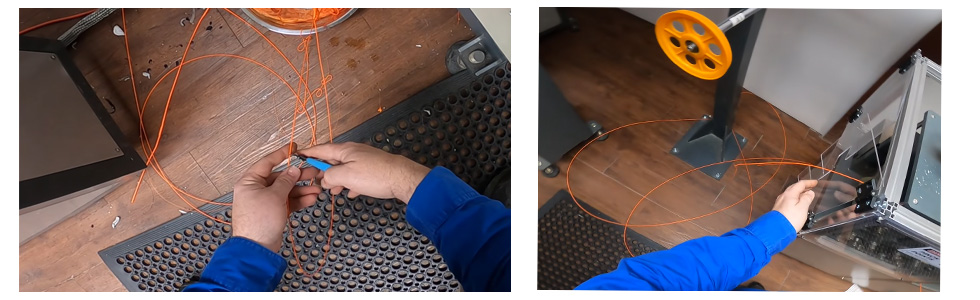
The main reason for 3D printing filament recycling is that the diameter of the filament does not meet customer requirements and needs to be reprocessed and produced again. This leads to wastage of the filament.
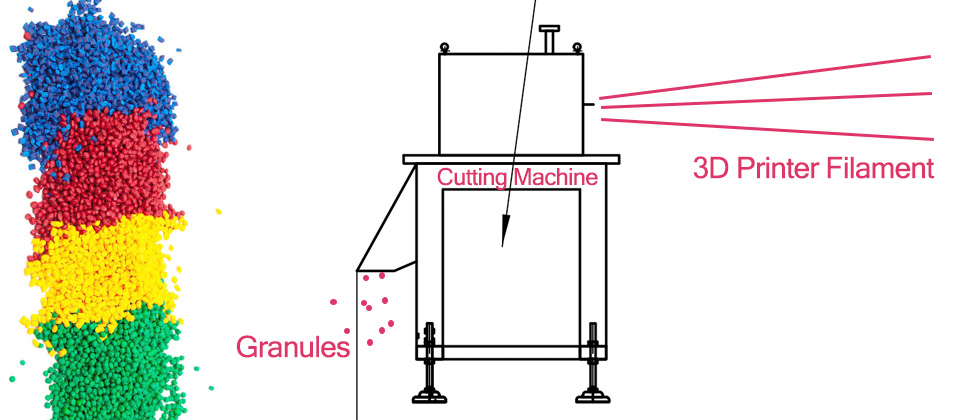
Şu 3D filament recycling machine is actually a plastic pellet cutting machine (Can view more details), with the same working principle, low price, small size, and can be placed in homes, schools, or factories.
Cut into uniform-sized pellets, then put them back into the 3D filament machine to make filaments. It is recommended to mix 85% to 90% new raw materials with 10% to 15% recycled materials to produce the filament. This way, the quality of the product can be guaranteed.
The value of recycling 3D filament
- Any raw material incurs costs, and recycling can save costs
- Some raw materials have high recycling rates, such as PETG, PEEK, ABS, etc., and the materials themselves are suitable for recycling and reuse
- The market price is extremely high, and so is the price in the recycling market, such as PETG, PEEK, ABS, etc.
- Reduce the harm of microplastics to daily life and nature, and protect the environment
The Bottom Line: Is a Filament Recycler Right for You?
As additive manufacturing transitions from rapid prototyping into mainstream production, sustainability is no longer optional. A 3D printer filament recycler transforms waste into a valuable manufacturing asset. For businesses, universities, and high-frequency makers, it represents a definitive step toward sustainable, self-sufficient, and cost-efficient production.
Ready to stop throwing away your failed 3D prints?
Get in touch with our team today to explore our line of industrial-grade shredders, high-precision filament extruders, and fully integrated closed-loop recycling systems designed to match your operational scale.